Businesses

Barclays Installed Big Brother-style Spyware on Employees' Computers (cityam.com) 108

Barclays has been criticised by HR experts and privacy campaigners after the bank installed "Big Brother" employee monitoring software in its London headquarters. From a report: Introduced as a pilot last week, the technology monitors Barclays workers' activity on their computers, and in some instances admonishes staff in daily updates to them if they are not deemed to have been active enough -- which is described as being in "the zone." The system tells staff to "avoid breaks" as it monitors their productivity in real-time, and records activities such as toilet visits as "unaccounted activity." A whistleblower at the banking giant told City A.M. that "the stress this is causing is beyond belief" and that it "shows an utter disregard for employee wellbeing." "Employees are worried to step away from their desks, have full lunch breaks, take bathroom breaks or even get up for water as we are not aware of the repercussions this might have on our statistics," they added. Big Brother Watch, a privacy campaign group, described the technology as "creepy." The software, provided by Sapience, has been rolled out throughout the product control department within the investment bank division at the firm's Canary Wharf headquarters. After the publication of the story, Barclays announced it is scrapping the program.
The Courts

New Mexico AG Sues Google For Allegedly Collecting Location Data, Contact Lists From Students (cnet.com) 13

An anonymous reader quotes a report from CNET: Google on Thursday was hit with a lawsuit by New Mexico Attorney General Hector Balderas, alleging the search giant is illegally collecting data on school children. The suit says Google is collecting the personal information through a program the company has with New Mexico's school districts, in which it provides Chromebooks and access to G Suite for Education apps for free. Those apps include Gmail, Calendar and Google Docs. The practice would run afoul of the Children's Online Privacy Protection Act, or COPPA, a federal law that regulates data collection from sites with users who are under 13 years old. The lawsuit accuses Google of collecting information on students' locations, their passwords, what websites they've visited, what they've searched for on Google and YouTube, their contact lists and voice recordings. Balderas also said in the lawsuit that Google "mined students' email accounts" and "extracted" information for advertising purposes until 2014. Google spokesman Jose Castaneda said in a statement: "These claims are factually wrong. G Suite for Education allows schools to control account access and requires that schools obtain parental consent when necessary. We do not use personal information from users in primary and secondary schools to target ads. School districts can decide how best to use Google for Education in their classrooms and we are committed to partnering with them."
Patents

'Project Magnum': Flywheel's Alleged Plot To Steal Peloton's Technology (vice.com) 77

em1ly writes: Spin bike maker Flywheel lost a patent lawsuit to rival company Peloton, announcing yesterday that it's shutting down. Motherboard uncovered some wild corporate espionage in the court documents: "At some point before the launch of FLY Anywhere, according to Peloton's lawyers, Flywheel launched 'Project Magnum,' an attempt to 'obtain as MUCH secret intel on Peloton as we can,' according to an improperly redacted document Peloton filed in court. 'Project Magnum was not some extemporaneous side-project [...] but rather a concerted, widespread effort,' one of Peloton's filings adds.

But Project Magnum was, apparently, more haphazard than spy operation. Flywheel created a Google Doc to 'create tabs with the functional areas of info so that the team know[s] to keep adding to it,' one of the documents reads. Much of the conspiracy seems to have taken place over email, judging by discovery that Peloton obtained. Someone at Flywheel named the project after the Magnum PI television series, one of the court documents adds, although the filing does not include the individual's name. The filings do not go into detail on how Flywheel apparently tried to obtain Peloton's secrets, but they do include contours of the project. In a message seemingly written by a former Flywheel CTO who now works at Facebook, he wrote 'Villency could be useful in providing insight related to Project Magnum.' Eric Villency, and his company Villency Design Group, designed the Peloton and SoulCycle stationary bikes..."

Facebook

Facebook Will Now Pay You For Your Voice Recordings (theverge.com) 10

After being caught listening to and transcribing voice recordings without informing customers, Facebook announced it will now offer to pay some users for voice recordings to help improve its speech recognition technology. The Verge reports: Facebook will let you make voice recordings as part of a new program called "Pronunciations" in its Viewpoints market research app. If you qualify to be part of the program, Facebook says you'll be able to record the phrase "Hey Portal" followed by the first name of a friend from your friends list. You'll be able to do this with the names of up to 10 friends, and you have to record each statement twice. Facebook won't be paying much for your recordings, though. If you complete one set of recordings, you get 200 points in the Viewpoints app -- and you can't cash out in the Viewpoints app until you earn at least 1,000 points. That only translates to a $5 reward via PayPal. However, Facebook says users may be offered the opportunity to make up to five sets of recordings, so there is the potential to meet that 1,000-point goal and get paid.
Social Networks

Should Facebook, Google Be Liable For User Posts? (reuters.com) 137

An anonymous reader quotes a report from Reuters: U.S. Attorney General William Barr on Wednesday questioned whether Facebook, Google and other major online platforms still need the immunity from legal liability that has prevented them from being sued over material their users post. "No longer are tech companies the underdog upstarts. They have become titans," Barr said at a public meeting held by the Justice Department to examine the future of Section 230 of the Communications Decency Act. "Given this changing technological landscape, valid questions have been raised about whether Section 230's broad immunity is necessary at least in its current form," he said.

Section 230 says online companies such as Facebook, Alphabet's Google and Twitter cannot be treated as the publisher or speaker of information they provide. This largely exempts them from liability involving content posted by users, although they can be held liable for content that violates criminal or intellectual property law. The increased size and power of online platforms has also left consumers with fewer options, and the lack of feasible alternatives is a relevant discussion, Barr said, adding that the Section 230 review came out of the Justice Department's broader look at potential anticompetitive practices at tech companies. Lawmakers from both major political parties have called for Congress to change Section 230 in ways that could expose tech companies to more lawsuits or significantly increase their costs. Barr said the department would not advocate a position at the meeting. But he hinted at the idea of allowing the U.S. government to take action against recalcitrant platforms, saying it was "questionable" whether Section 230 should prevent the American government from suing platforms when it is "acting to protect American citizens."
The attorney general of Nebraska, Doug Peterson, noted that the law does not shield platforms from federal criminal prosecution; the immunity helps protect against civil claims or a state-level prosecution. Peterson said the exception should be widened to allow state-level action as well. Addressing the tech industry, he called it a "pretty simple solution" that would allow local officials "to clean up your industry instead of waiting for your industry to clean up itself."

Matt Schruers, president of the Computer and Communications Industry Association, which counts Google and Facebook among its members, said such a solution would result in tech giants having to obey 50 separate sets of laws governing user content. He suggested law enforcement's energies might be better spent pursuing the millions of tips that the tech industry sent over every year, only a small fraction of which, he noted, resulted in investigations.
Businesses

A Group of Ex-NSA and Amazon Engineers Are Building a 'GitHub For Data' (techcrunch.com) 21

A group of engineers and developers with backgrounds from the National Security Agency, Google, and Amazon Web Services are working on Gretel, an early-stage startup that aims to help developers safely share and collaborate with sensitive data in real time. TechCrunch reports: It's not as niche of a problem as you might think, said Alex Watson, one of the co-founders. Developers can face this problem at any company, he said. Often, developers don't need full access to a bank of user data -- they just need a portion or a sample to work with. In many cases, developers could suffice with data that looks like real user data. "It starts with making data safe to share," Watson said. "There's all these really cool use cases that people have been able to do with data." He said companies like GitHub, a widely used source code sharing platform, helped to make source code accessible and collaboration easy. "But there's no GitHub equivalent for data," he said.

And that's how Watson and his co-founders, John Myers, Ali Golshan and Laszlo Bock came up with Gretel. "We're building right now software that enables developers to automatically check out an anonymized version of the data set," said Watson. This so-called "synthetic data" is essentially artificial data that looks and works just like regular sensitive user data. Gretel uses machine learning to categorize the data -- like names, addresses and other customer identifiers -- and classify as many labels to the data as possible. Once that data is labeled, it can be applied access policies. Then, the platform applies differential privacy -- a technique used to anonymize vast amounts of data -- so that it's no longer tied to customer information. "It's an entirely fake data set that was generated by machine learning," said Watson.
The startup has already raised $3.5 million in seed funding. "Gretel said it will charge customers based on consumption -- a similar structure to how Amazon prices access to its cloud computing services," adds TechCrunch.
Education

UCLA Abandons Plans To Use Facial Recognition After Backlash (vice.com) 19

Ahead of a national day of action led by digital rights group Fight for the Future, UCLA has abandoned its plans to become the first university in the United States to adopt facial recognition technology. From a report: In a statement shared with Fight for the Future's Deputy Director Evan Greer, UCLA's Administrative Vice Chancellor Michael Beck said the university "determined that the potential benefits are limited and are vastly outweighed by the concerns of the campus community." Since last year, UCLA has been considering using the university's security cameras to implement a facial recognition surveillance system.

These plans have been dogged by student criticism, culminating in an editorial in the Daily Bruin, UCLA's student newspaper, that argued the system would "present a major breach of students' privacy" while creating "a more hostile campus environment" by "collecting invasive amounts of data on [UCLA's] population of over 45,000 students and 50,000 employees." In an attempt to highlight the risks of using facial recognition on UCLA's campus, Fight for the Future used Amazon's facial recognition software, Rekognition, to scan public photos of UCLA's athletes and faculty, then compare the photos to a mugshot database. Over 400 photos were scanned, 58 of which were false positives for mugshot images -- the software often gave back matches with "100% confidence" for individuals "who had almost nothing in common beyond their race"

Privacy

Leaked Document Shows How Big Companies Buy Credit Card Data On Millions of Americans (vice.com) 29

An anonymous reader quotes a report from Motherboard: Yodlee, the largest financial data broker in the U.S., sells data pulled from the bank and credit card transactions of tens of millions of Americans to investment and research firms, detailing where and when people shopped and how much they spent. The company claims that the data is anonymous, but a confidential Yodlee document obtained by Motherboard indicates individual users could be unmasked. The findings come as multiple Senators have urged the Federal Trade Commission (FTC) to investigate Envestnet, which owns Yodlee, for selling Americans' transaction information without their knowledge or consent, potentially violating the law.

The Yodlee document describes in detail what type of data its clients gain access to, how the company manages that data across its infrastructure, and the specific measures Yodlee takes to try and anonymize its dataset. The transaction data itself comes from banks, credit card companies, and apps that Yodlee works with, including Bank of America, Citigroup, and HSBC, according to previous reporting from The Wall Street Journal. According to the 2019 document Motherboard obtained, the data includes a unique identifier given to the bank or credit card holder who made the purchase; the amount spent for the transaction; the date of the sale; the city, state, and zip code of the business the person bought from, and other pieces of metadata. Once logged into Yodlee's server, clients download the data as a large text file, rather than interacting with the data in a dashboard or interface that stays solely within Yodlee's control, according to the document.
Yodlee does remove personal identifiable information (PII), such as names, email addresses, account numbers, SSNs, and phone numbers, but it "does not remove spatio-temporal traces of people that can be used to connect back the data to them," says Vivek Singh, assistant professor at Rutgers University. As Motherboard notes, "spatio-temporal traces are the various pieces of metadata that the document shows are included with the transaction -- the date, the merchant, the physical location of the sale, and more."

"If an attacker can get hold of the spatio-temporal coordinates for just three to four randomly picked transactions in the dataset, then the attacker can unmask the person with a very high probability. With this unmasking, the attacker would have access to all the other transactions made by that individual," Singh said.
United Kingdom

Google Users In UK To Lose EU Data Protection: Reuters (reuters.com) 70

Sources told Reuters that Google is planning to move its British users' accounts out of the control of European Union privacy regulators, placing them under U.S. jurisdiction instead. From the report: The shift, prompted by Britain's exit from the EU, will leave the sensitive personal information of tens of millions with less protection and within easier reach of British law enforcement. The change was described to Reuters by three people familiar with its plans. Google intends to require its British users to acknowledge new terms of service including the new jurisdiction.

Ireland, where Google and other U.S. tech companies have their European headquarters, is staying in the EU, which has one of the world's most aggressive data protection rules, the General Data Protection Regulation. Google has decided to move its British users out of Irish jurisdiction because it is unclear whether Britain will follow GDPR or adopt other rules that could affect the handling of user data, the people said. If British Google users have their data kept in Ireland, it would be more difficult for British authorities to recover it in criminal investigations.

Facebook

IRS Sues Facebook For $9 Billion, Says Company Offshored Profits To Ireland (foxbusiness.com) 103

An anonymous reader quotes a report from Fox Business: Facebook is slated to begin a tax trial in a San Francisco court on Tuesday, as the Internal Revenue Service tries to convince a judge the world's largest social media company owes more than $9 billion linked to its decision to shift profits to Ireland. The trial, which Facebook expects will take three to four weeks, could see top executives including hardware chief Andrew Bosworth and Chief Technology Officer Mike Schroepfer called to testify, according to a document the company filed in January. The witness list also includes Naomi Gleit and Javier Olivan, veterans of Facebook's aggressive growth team, and Chief Revenue Officer David Fischer.

The IRS argues that Facebook understated the value of the intellectual property it sold to an Irish subsidiary in 2010 while building out global operations, a move common among U.S. multinationals. Ireland has lower corporate tax rates than the United States, so the move reduced the company's tax bill. Under the arrangement, Facebook's subsidiaries pay royalties to the U.S.-based parent for access to its trademark, users and platform technologies. From 2010 to 2016, Facebook Ireland paid Facebook U.S. more than $14 billion in royalties and cost-sharing payments, according to the court filing. The company said the low valuation reflected the risks associated with Facebook's international expansion, which took place in 2010 before its IPO and the development of its most lucrative digital advertising products.

Privacy

Indian Police Open Case Against Hundreds in Kashmir For Using VPN (techcrunch.com) 46

Local authorities in India-controlled Kashmir have opened a case against hundreds of people who used virtual private networks (VPNs) to circumvent a social media ban in the disputed Himalayan region in a move that has been denounced by human rights and privacy activists. From a report: Tahir Ashraf, who heads the police cyber division in Srinagar, said on Tuesday that the authority had identified and was probing hundreds of suspected users who he alleged misused social media to promote "unlawful activities and secessionist ideology." On Monday, the police said they had also seized "a lot of incriminating material" under the Unlawful Activities Prevention Act (UAPA), the nation's principal counter-terrorism law. Those found guilty could be jailed up to seven years. "Taking a serious note of misuse of social media, there have been continuous reports of misuse of social media sites by the miscreants to propagate the secessionist ideology and to promote unlawful activities," the region's police said in a statement. The move comes weeks after the Indian government restored access to several hundred websites, including some shopping websites such as Amazon India and Flipkart and select news outlets in the disputed region. Facebook, Twitter and other social media services remain blocked, and mobile data speeds remain capped at 2G speeds.
Firefox

Mozilla's Standalone Firefox VPN is Now Available in Beta (cnet.com) 19

Mozilla has a new virtual private network service and if you have a Chromebook, a Windows 10 computer or an Android device in the US, you can start using a beta version now. From a report: Called Firefox Private Network, the new service is designed to function as a full-device VPN and give better protection when surfing the web or when using public Wi-Fi networks. The company offers two options: a free browser-extension version, which it launched in beta last year, that provides 12 one-hour VPN passes when using the Firefox browser and a Firefox account; and a second, $4.99-a-month option that provides a more complete VPN service across your whole device. The new paid option, which runs off of servers provided by Swedish open-source VPN company Mullvad, can protect up to five devices with one account. It allows for faster browsing and streaming, and gives you the ability to tap into servers located in "30-plus countries" for masking your location data.
The Courts

Donald Trump 'Offered Julian Assange a Pardon if He Denied Russia Link To Hack' (theguardian.com) 510

Donald Trump offered Julian Assange a pardon if he would say Russia was not involved in leaking Democratic party emails, a court in London has been told. From a report: The extraordinary claim was made at Westminster magistrates court before the opening next week of Assange's legal battle to block attempts to extradite him to the US. Assange's barrister, Edward Fitzgerald QC, referred to evidence alleging that the former US Republican congressman Dana Rohrabacher had been to see Assange, now 48, while he was still in the Ecuadorian embassy in August 2017. A statement from Assange's lawyer Jennifer Robinson shows "Mr Rohrabacher going to see Mr Assange and saying, on instructions from the president, he was offering a pardon or some other way out, if Mr Assange ... said Russia had nothing to do with the DNC leaks," Fitzgerald told Westminster magistrates court.

A series of emails that were highly embarrassing for the Democrats and Hillary Clinton's presidential campaign were hacked before being published by WikiLeaks in 2016. District Judge Vanessa Baraitser, who is hearing the case at Westminster, said the evidence is admissible. Assange is wanted in America to face 18 charges, including conspiring to commit computer intrusion, over the publication of US cables a decade ago. He could face up to 175 years in jail if found guilty. He is accused of working with the former US army intelligence analyst Chelsea Manning to leak hundreds of thousands of classified documents.

China

Malaysian Firm Offers AI-Based Profiling of Chinese Visitors for Virus (reuters.com) 7

Malaysia's MYEG Services said on Wednesday it had developed a coronavirus risk-profiling system for visitors from China and was offering the artificial intelligence-based service to the governments of Malaysia and the Philippines. From a report: Malaysia has imposed a temporary ban on visitors from Chinese provinces placed on lockdown by the China's government, in a bid to stem the spread of the virus. Malaysia has reported 22 infections, and the Philippines has reported three confirmed cases including one death. MYEG Services Bhd said its system creates a health-risk profile using a person's historical geolocation information and other parameters. MYEG has partnered with Beijing-based travel agency Phoenix Travel Worldwide for the project. The fully-automated system analyses a "vast number of available data points, including visitors' previous known whereabouts as well as heart rate and blood pressure readings crossed-referenced against public transportation ridership and exposure to locations with incidences of infections," MYEG said in a statement to the stock exchange.
The Courts

ISPs Sue Maine, Claim Web-Privacy Law Violates Their Free-Speech Rights (arstechnica.com) 126

An anonymous reader quotes a report from Ars Technica: The broadband industry is suing Maine to stop a Web-browsing privacy law similar to the one killed by Congress and President Donald Trump in 2017. Industry groups claim the state law violates First Amendment protections on free speech and the Supremacy Clause of the US Constitution. The Maine law was signed by Democratic Gov. Janet Mills in June 2019 and is scheduled to take effect on July 1, 2020. It requires ISPs to get customers' opt-in consent before using or sharing sensitive data. As Mills' announcement in June said, the state law "prohibits a provider of broadband Internet access service from using, disclosing, selling, or permitting access to customer personal information unless the customer expressly consents to that use, disclosure, sale or access. The legislation also prohibits a provider from refusing to serve a customer, charging a customer a penalty or offering a customer a discount if the customer does or does not consent to the use, disclosure, sale or access of their personal information."

Customer data protected by this law includes Web-browsing history, application-usage history, precise geolocation data, the content of customers' communications, IP addresses, device identifiers, financial and health information, and personal details used for billing. Home Internet providers and wireless carriers don't want to seek customer permission before using Web-browsing histories and similar data for advertising or other purposes. On Friday, the four major lobby groups representing the cable, telco, and wireless industries sued the state in US District Court for the District of Maine, seeking an injunction that would prevent enforcement of the law.
In the lawsuit, the groups said the state law "imposes unprecedented and unduly burdensome restrictions on ISPs', and only ISPs', protected speech," while imposing no requirements on other companies that deliver services over the internet. The plaintiffs are America's Communications Association, CTIA, NCTA, and USTelecom.

The law allegedly violates the First Amendment because it "limits ISPs from advertising or marketing non-communications-related services to their customers; and prohibits ISPs from offering price discounts, rewards in loyalty programs, or other cost-saving benefits in exchange for a customer's consent to use their personal information," the lawsuit claims. As for how the Maine law violates the Supremacy Clause, the lawsuit says it's "because it allows consumers to dictate (by opting out or declining to opt in) when ISPs can use or disclose information that they must rely on to comply with federal law, rendering 'compliance with both' state and the foregoing federal laws 'impossible.'"
China

China Enlists Tech Titans To Help It Track Coronavirus With Color-Based QR Codes (gizmodo.com) 22

In its latest dystopian stab at curbing the spread of COVID-19, the Chinese government has employed two of the biggest tech giants in Asia to help it roll out a nationwide color-based tracking system to keep tabs on those suffering from coronavirus symptoms, according to a new report. From a report: Companies enlisted for this real-life sci-fi movie endeavor to contain COVID-19 -- the World Health Organization's name for the deadly coronavirus behind this global health emergency -- include Alibaba Group Holdings, Asia's largest digital advertising, e-commerce, and cloud platform as well as Tencent Holdings, one of the world's largest video game companies and the force behind the popular messaging app WeChat. As part of a collaboration with Beijing, Alipay, a payment app operated by Alibaba's subsidiary Ant Financial, recently released a new feature that sends a color-based QR code to individuals via smartphone based on their answers to an online health survey. Depending on what symptoms they've been experiencing or whether they've traveled recently, they're assigned one of three colors that's tied to their ID number. Green means the user can travel freely; yellow prompts instructions for the user to remain quarantined for seven days; and red -- used in the most severe cases -- carries a 14-day quarantine period and instructs users to regularly check-in via an Alibaba chat app.
Piracy

Don't Use the Word 'Did' Or a Dumb Anti-Piracy Company Will Delete You From Google (torrentfreak.com) 165

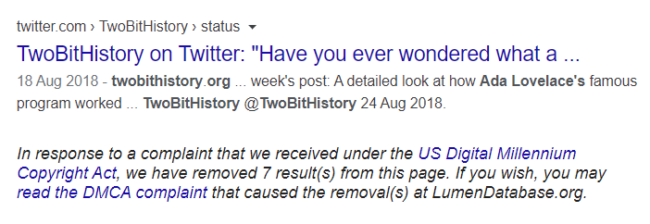
In 2018, the owner of Two-Bit History, a site dedicated to computer history, wrote a successful article about mathematician Ada Lovelace, who some credit as being the first computer programmer. Sadly, if you search Google for that article today you won't find it. Some idiotic anti-piracy company had it deleted because it dared to use the word "did." TorrentFreak reports: In 2018, [Sinclair Target, the owner of computing history blog, Two-Bit History] wrote an article about Ada Lovelace, the daughter of Lord Byron who some credit as being the world's first computer programmer, despite being born in 1815. Unfortunately, however, those who search for that article today using Google won't find it. As the image below shows, the original Tweet announcing the article is still present in Google's indexes but the article itself has been removed, thanks to a copyright infringement complaint that also claimed several other victims.

Sinclair's article was deleted because an anti-piracy company working on behalf of a TV company decided that since its title (What Did Ada Lovelace's Program Actually Do?) contained the word 'DID,' it must be illegal. This monumental screw-up was announced on Twitter by Sinclair himself, who complained that "Computers are stupid folks. Too bad Google has decided they are in charge." At risk of running counter to Sinclair's claim, in this case -- as Lovelace herself would've hopefully agreed -- it is people who are stupid, not computers. The proof for that can be found in the DMCA complaint sent to Google by RightsHero, an anti-piracy company working on behalf of Zee TV, an Indian pay-TV channel that airs Dance India Dance. Now in its seventh season, Dance India Dance is a dance competition reality show that is often referred to as DID. And now, of course, you can see where this is going. Because Target and at least 11 other sites dared to use the word in its original context, RightsHero flagged the pages as infringing and asked Google to deindex them.
In the complaint sent to Google, "the notice not only claims Target's article is infringing the copyrights of Dance India Dance (sorry, DID), but also no less than four online dictionaries explaining what the word 'did actually means," adds TorrentFreak. "Perhaps worse still, some of the other allegedly-infringing articles were published by some pretty serious information resources [including the U.S. Department of Education, Nature.com, and USGS Earthquake Hazards Program of the U.S. Geological Survey]."
United States

US Mulls Cutting Huawei Off From Global Chip Suppliers (reuters.com) 137

The Trump administration is considering changing U.S. regulations to allow it to block shipments of chips to Huawei from companies such as Taiwan's TSMC, the world's largest contract chipmaker. Reuters reports: New restrictions on commerce with China's Huawei are among several options to be considered at high-level U.S. meetings this week and next. The chip proposal has been drafted but its approval is far from certain, one of the sources said. The measure would be a blow to the world's no. 2 smartphone maker as well as to TSMC, a major producer of chips for Huawei's HiSilicon unit and mobile phone rivals Apple and Qualcomm.

"What they're trying to do is make sure that no chips go to Huawei that they can possibly control," the second source said. To target global chip sales to Huawei, U.S. authorities would alter the Foreign Direct Product Rule, which subjects some foreign-made goods based on U.S. technology or software to U.S. regulations. Under the draft proposal, the U.S. government would force foreign companies that use U.S. chipmaking equipment to seek a U.S. license before supplying Huawei -- a major expansion of export control authority that could anger U.S. allies worldwide.

Android

Google Confirms It Again Removed Alleged Spying Tool ToTok From Google Play (techcrunch.com) 3

Google has confirmed that the popular messaging app ToTok, which is actually a spying tool used by the United Arab Emirates to track the activities of those who download it, has again been removed from the Play Store. But this time they declined to comment as to why. TechCrunch reports: Reached for comment, Google confirmed to TechCrunch that it removed the app from Google Play. In addition, Google noted the enforcement was not done in response to any external direction or request. That means the U.S. government did not get involved here, rather that Google chose to remove the app itself -- likely for a policy violation. According to The NYT's original report, ToTok had been downloaded millions of times from both Apple and Google's app stores by customers across the Middle East, Europe, Asia, Africa and North America in the few months since its launch. Citing unnamed U.S. intelligence sources, the report claimed the app had been used to track its users' "every conversation, movement, relationship, appointment, sound, and image."

At the time of the app's removal, Google said the app had violated unspecified Google Play policies. The app had over 10 million installs by then, app intelligence firm Sensor Tower says. In January, ToTok's website announced the app was again available for download. The updated version submitted to Google Play included a new dialog that requested authorization to access and sync users' contact list, Vice reported. Oddly, this updated version of ToTok never ranked on Google Play's charts again.

Twitter

Twitter Locks WikiLeaks Official Account With 5.4 Million Followers, Days Before Julian Assange's Extradition Hearing 75

Days before Julian Assange's extradition hearings are set to continue, WikiLeaks' journalist Kristin Hrafnsson reports that the official WikiLeaks twitter account has been locked. "All attempts to get it reopened via regular channels have been unsuccessful," writes Hrafnsson in a tweet. "It has been impossible to reach a human at twitter to resolve the issue. Can someone fix this?" RT reports: The @wikileaks account's most recent posts date back to February 9 and concern the dire precedent set by extraditing a publisher to stand trial on espionage charges. Assange's extradition hearing in the UK, which a court ordered to be split into two parts, is set to begin next week, while the second half is scheduled for May. The publisher's lawyers have complained that access to their client is being restricted, and Assange was only recently moved from solitary confinement at Belmarsh prison after his fellow inmates staged a protest. The UN special rapporteur on torture Nils Melzer has accused the UK government of contributing to Assange's "psychological torture" after examining the activist last year. ZeroHedge also points out that this isn't the first time WikiLeaks' account was locked. In 2016, "Twitter lit up in late July with allegations that it tried to suppress news that secret-leaking website Wikileaks exposed thousands of emails obtained from the servers of the Democratic National Committee," reports ZeroHeads, citing The Washington Examiner. "Friday afternoon, users noted, '#DNCLeaks' was trending, with more than 250,000 tweets about it on the platform. By Friday evening, it vanished completely from the site's 'trending' bar for at least 20 minutes. It returned as '#DNCLeak' after users erupted, though it was too late to quell their rage."

For what it's worth, Twitter CEO Jack Dorsey at the time denied any attempt to intentionally silence the account.

Slashdot Top Deals