Government

Bill Gates, Lancet, UN, and Many Others Lambast America's Withholding of Funds from the WHO (thehill.com) 373

This week U.S. president Donald Trump suspended America's $900 million annual contribution to the World Health Organization. Richard Horton, editor-in-chief of the prestigious medical journal The Lancet, called Trump's move a "crime against humanity...."

The Hill reports: "Every scientist, every health worker, every citizen must resist and rebel against this appalling betrayal of global solidarity," he added...

The American Medical Association (AMA) late Tuesday called Trump's decision a "dangerous step in the wrong direction" and urged him to reconsider. "Fighting a global pandemic requires international cooperation and reliance on science and data. Cutting funding to the WHO — rather than focusing on solutions — is a dangerous move at a precarious moment for the world," the AMA said in a statement. European Union foreign policy chief Josep Borrell, meanwhile, said Wednesday that there was "no reason justifying" Trump's move...

And Bill Gates said in a tweet that halting funding to the WHO amid a world health crisis "is as dangerous as it sounds."

"Their work is slowing the spread of COVID-19 and if that work is stopped no other organization can replace them," the Microsoft co-founder and billionaire philanthropist added. "The world needs @WHO now more than ever."

Agreeing with Bill Gates was 95-year-old former U.S. president Jimmy Carter. Newsweek quotes Carter's newly-released statement calling the WHO "the only international organization capable of leading the effort to control this virus."

The head of the United Nations also called the WHO "absolutely critical to the world's efforts to win the war against COVID-19."

While criticizing the WHO, this week an article in the Atlantic called president Trump's moves "a transparent effort to distract from his administration's failure to prepare for the COVID-19 pandemic." The Democrats speaker of the House added that Trump's decision "is dangerous, illegal and will be swiftly challenged."

But the science magazine Nature still published an editorial harshly criticizing Trump's attempt to defund the WHO. "[E]ven talk of doing so in the middle of a global health and economic crisis cannot be condemned strongly enough." They argue that withholding America's funds "will place more lives at risk and ensure that the world takes longer to emerge from this crisis... It is right that researchers, funders and governments have been protesting against Trump's decision, and they must continue to do so in the strongest terms."

And Newsweek also published the comments of the WHO's Director-General, who had this message for its critics. "[O]ur focus, my focus, is on stopping this virus and saving lives... This is a time for all of us to be united in our common struggle against a common threat, a dangerous enemy.

"When we're divided, the virus exploits the cracks between us."
Netscape

Silicon Valley Legends Launch 'Beyond Identity' To Eliminate All Passwords (securityweek.com) 143

SecurityWeek editor wiredmikey shares new that Jim Clark and Tom Jermoluk (past founders of Netscape, Silicon Graphics and @Home Network) "have launched a phone-resident personal certificate-based authentication and authorization solution that eliminates all passwords."

Security Week reports: The technology used is not new, being based on X.509 certificates and SSL (invented by Netscape some 25 years ago and still the bedrock of secure internet communications). It is the opportunity provided by the modern smartphone with biometric user access, enough memory and power, and a secure enclave to store the private keys of a self-certificate that never leaves the device that is new. The biometric access ties the phone to its user, and the Beyond Identity certificate authenticates the device/user to the service provider, whether that's a bank or a corporate network...

"When this technology was created at Netscape during the beginning of the World Wide Web, it was conceived as a mechanism for websites to securely communicate, but the tools didn't yet exist to extend the chain all the way to the end user," commented Jermoluk. "Beyond Identity includes the user in the same chain of certificates bound together with the secure encrypted transport (TLS) used by millions of websites in secure communications today...."

With no passwords, the primary cause of data breaches (either to steal passwords or by using stolen passwords) is gone. It removes all friction from the access process, takes the password reset load off the help desk, and can form the basis of a zero-trust model where identity is the perimeter.

Though they're first focusing on the corporate market, their solution should be available to consumers by the end of 2020, the article reports, which speculates that the possibility of pre-also installing the solution on devices "is not out of the question."
Privacy

The Tor Project Lays Off 37% of Its Staff (torproject.org) 43

The Tor Project's executive director Isabela Bagueros writes: Tor, like much of the world, has been caught up in the COVID-19 crisis. Like many other nonprofits and small businesses, the crisis has hit us hard, and we have had to make some difficult decisions.

We had to let go of 13 great people who helped make Tor available to millions of people around the world. We will move forward with a core team of 22 people, and remain dedicated to continuing our work on Tor Browser and the Tor software ecosystem.

The world won't be the same after this crisis, and the need for privacy and secure access to information will become more urgent. In these times, being online is critical and many people face ongoing obstacles to getting and sharing needed information. We are taking today's difficult steps to ensure the Tor Project continues to exist and our technology stays available.

We are terribly sad to lose such valuable teammates, and we want to let all our users and supporters know that Tor will continue to provide privacy, security, and censorship circumvention services to anyone who needs them.

Mashable reminds its readers that "Those wishing to make sure the specifics of their online browsing remain their own personal business can donate to Tor's non-profit organization.

"Because with more and more of our lives happening online for the foreseeable future, it's a good idea to have an organization working to protect what little digital privacy we have left."
Privacy

Growth In Surveillance May Be Hard To Scale Back After Pandemic, Experts Say (theguardian.com) 96

Long-time Slashdot reader AmiMoJo quotes the Guardian: The coronavirus pandemic has led to an unprecedented global surge in digital surveillance, researchers and privacy advocates around the world have said, with billions of people facing enhanced monitoring that may prove difficult to roll back.

Governments in at least 25 countries are employing vast programmes for mobile data tracking, apps to record personal contact with others, CCTV networks equipped with facial recognition, permission schemes to go outside and drones to enforce social isolation regimes.

The methods have been adopted by authoritarian states and democracies alike and have opened lucrative new markets for companies that extract, sell, and analyse private data. One of the world's foremost experts on mobile phone surveillance said the pandemic had created a '9/11 on steroids' that could lead to grave abuses of power.

"Most of these measures don't have sunset clauses. They could establish what many people are describing as a new normal," Ron Deibert, who heads the Citizen Lab at the University of Toronto, said in an interview with the Guardian.

The article provides examples from China, Russia, India, Europe, and the United States, and provides a link to an index of new coronavirus-related surveillance measures related to the coronavirus outbreak. The digital rights lead at the group behind the list says "This isn't just an issue with authoritarian governments. This is happening across the world."
Piracy

The Pirate Bay Blocked By MalwareBytes But Normal Service Will Be Resumed (torrentfreak.com) 16

The Pirate Bay returned to the clear web this week after a month-long hiatus. However, the structure of the infamous torrent index presented an access problem to users of the popular anti-malware software MalwareBytes, which persistently blocked an essential element of the platform due to the presence of "a few" cryptocurrency miners on a secondary domain. TorrentFreak reports: The problem lay in The Pirate Bay's setup. Aside from cosmetic changes to some pages, the site sends requests to another domain (apibay.org) in order to present torrents to the user on thepiratebay.org. However, those accessing the main domain with Malwarebytes installed were greeted with blank torrent pages after the security software blocked apibay.org. Any warning of this type, especially concerning trojans, should be of concern to users of any site. However, dumping trojans on users hasn't been the modus operandi of The Pirate Bay thus far, so TorrentFreak contacted Malwarebytes to find out what was causing the alert.

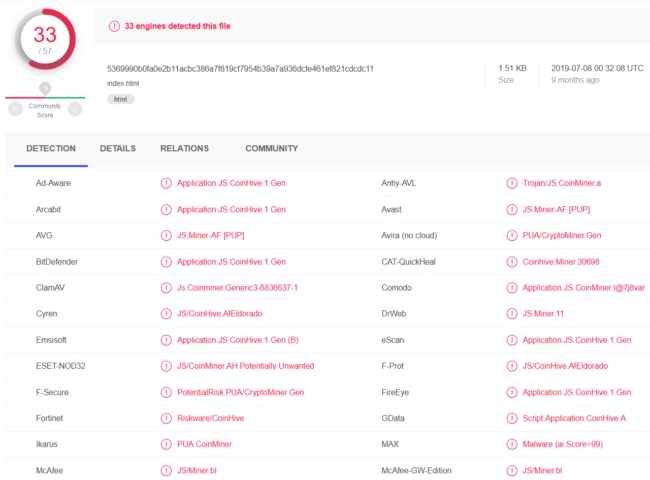
Manager of WebProtection Labs at MalwareBytes Andres Ortiz informs TorrentFreak that the issue was caused by the presence of "a few" cryptocurrency miners, not on thepiratebay.org, but on a sub-directory of apibay.org, the domain from where TPB appears to present its torrent results. The analysis for just one example miner is shown [here]. After examining the apibay.org domain once again, MalwareBytes has now confirmed that the miners have been removed so in response, they will push an update to their users to stop TPB's indexes from being blocked moving forward. However, if any party reintroduces the miners, it's certainly possible that the site will be rendered inaccessible once again.

Communications

FCC To Approve 5G Network Despite Military Saying It Will Harm GPS (arstechnica.com) 56

An anonymous reader quotes a report from Ars Technica: The Federal Communications Commission is set to approve a new 5G cellular network despite claims from the Department of Defense that it will interfere with Global Positioning System (GPS) services. FCC Chairman Ajit Pai today asked fellow commissioners to approve an "application to deploy a low-power terrestrial nationwide network in the L-Band that would primarily support 5G and Internet of Things services." The application is from Ligado, formerly known as LightSquared, which for nearly a decade has sought permission to build a wireless network using frequencies near those used for GPS. A previous failure to obtain FCC approval helped push LightSquared into bankruptcy.

The FCC said its draft order would "ensure that adjacent band operations, including GPS, are protected from harmful interference." Pai said the FCC has "compiled an extensive record, which confirms that it is in the public interest to grant Ligado's application while imposing stringent conditions to prevent harmful interference." He continued: "Although I appreciate the concerns that have been raised by certain Executive Branch agencies, it is the Commission's duty to make an independent determination based on sound engineering. And based on the painstaking technical analysis done by our expert staff, I am convinced that the conditions outlined in this draft order would permit Ligado to move forward without causing harmful interference. For example, the draft order would authorize downlink operations at a power level that represents a greater than 99 percent reduction from what Ligado proposed in its 2015 application."
The base-station power reduction is "from 32dBW to 9.8dBW," and Ligado committed to a 23MHz "guard-band using its own licensed spectrum to further separate its terrestrial base station transmissions from neighboring operation," the FCC said. "As such, Ligado is now only seeking terrestrial use of the 1526-1536MHz, 1627.5-1637.5MHz, and 1646.5-1656.5MHz bands."

Ligado isn't competing directly against the big telecom giants. Instead, the company "plans to deliver custom private networks for industrial firms, service for [IoT] devices and unmanned systems, and connectivity for other business and government use cases," reports Ars. "Ligado could also supply capacity to the major wireless carriers."
Privacy

India Says Zoom 'Not a Safe Platform' For Video Conferencing (reuters.com) 49

India is the latest country to denounce videoconferencing software Zoom, calling it "not a safe platform." Reuters reports: "Zoom is a not a safe platform," the Cyber Coordination Centre (CyCord) of India's ministry of home affairs said in a 16-page advisory. The government body also provided guidelines on how to avoid unauthorized users from carrying out malicious acts while using the tool. Zoom's mobile app saw a sharp surge in downloads in India as the country enforced a nationwide lockdown late last month to curb the spread of the coronavirus. Even some Indian government officials have held discussions with industry executives to discuss coronavirus relief measures via Zoom. One media report this week said the Indian government was advising its ministers not to use third-party software for sensitive meetings.
EU

Google, Apple Covid-19 Tracking Tech Faces EU Scrutiny (bloomberg.com) 68

The European Union said it will scrutinize Google and Apple's proposed contact-tracing technology to ensure it meets the bloc's new standards governing the deployment of Covid-19 apps. From a report: Officials from member states and the EU's executive arm will "seek clarifications on the solution proposed by Google and Apple," the European Commission said on Thursday as it issued guidelines aimed at making the various virus-tracking apps interoperable. Alphabet's Google and Apple late last week announced they would add technology to their platforms to alert users if they have come into contact with a person with the coronavirus. While the system is voluntary, it has the potential to monitor about a third of the world's population. In a video-conference earlier this week with Google CEO Sundar Pichai and YouTube CEO Susan Wojcicki, EU Industry Commissioner Thierry Breton "insisted on the need for all digital actors to develop apps to trace the spread of the virus in full respect of the privacy of individuals and ensuring interoperability and security of communications," the EU said.
United States

New York Orders Residents To Wear Masks In Public (nytimes.com) 247

An anonymous reader quotes a report from The New York Times: Imposing a stricter measure to control the spread of the coronavirus, Gov. Andrew M. Cuomo said on Wednesday that he would start requiring people in New York to wear masks or face coverings in public whenever social distancing was not possible. The order will take effect on Friday and will apply to people who are unable to keep six feet away from others in public settings, such as on a bus or subway, on a crowded sidewalk or inside a grocery store.

Mr. Cuomo said local governments would enforce the order, but he noted that riders without face coverings would not be ejected from public transit. The pandemic has devastated New York's public transit system, with 59 workers having died of the virus and 2,269 testing positive for the infection. The state would consider issuing civil penalties to people who fail to abide by the order, but not criminal penalties: "You're not going to go to jail for not wearing a mask," Mr. Cuomo said. Permitted face coverings include proper masks, as well as scarves or bandannas, the governor said.
Maryland and New Jersey have also issued similar rules.
The Courts

Former Tesla Employees Brought Stolen Documents To Self-Driving Startup Zoox (theverge.com) 45

Self-driving startup Zoox has admitted that four of its employees took confidential documents from their previous employer Tesla, according to a statement issued after the company settled a lawsuit this week over the matter. The Verge reports: "Zoox acknowledges that certain of its new hires from Tesla were in possession of Tesla documents pertaining to shipping, receiving, and warehouse procedures when they joined Zoox's logistics team," the startup said in a statement to Reuters. Zoox says it will pay Tesla an undisclosed amount of money and will perform an audit to "ensure that no Zoox employees have retained or are using Tesla confidential information." Zoox says it "regrets the actions of those employees," and says it will also "conduct enhanced confidentiality training to ensure that all Zoox employees are aware of and respect their confidentiality obligations."
Businesses

Amazon Halts Activity At French Warehouses After Court Order (bloomberg.com) 233

Amazon said it will stop activity at its fulfillment centers in France for five days after a court order banned the sale of non-essential goods. Bloomberg reports: The world's largest online retailer is "temporarily" suspending sales from April 16 through April 20, a spokeswoman for the company said. The court concluded the retailer isn't doing enough to protect staff from the Covid-19 pandemic. The $1.1 trillion company was given 24 hours on Tuesday to comply with the ruling to sell only essential items such as food and hygiene products, and to upgrade its health-security procedures. The company faces fines of 1 million euros ($1.1 million) for each day's delay.

Amazon said the ruling left it "perplexed," and noted it has already taken extra steps to protect employee health. "The court gave categories that are very general and create ambiguity that would be too hard to implement," a spokeswoman for Amazon told Bloomberg News. "This is a complex business to run." Amazon must shut down "because of the terms and conditions of the court order, especially because of their ambiguity and the absence of definition," the e-commerce giant said in an internal memo that was seen by Bloomberg.

Privacy

Hackers Are Selling a Critical Zoom Zero-Day Exploit for $500,000 (vice.com) 38

Hackers are selling two critical vulnerabilities for the video conferencing software Zoom that would allow someone to hack users and spy on their calls, Motherboard reported Wednesday. From the report: The two flaws are so-called zero-days, and are currently present in Zoom's Windows and MacOS clients, according to three sources who are knowledgeable about the market for these kinds of hacks. The sources have not seen the actual code for these vulnerabilities, but have been contacted by brokers offering them for sale. Zero-day exploits or just zero-days or 0days are unknown vulnerabilities in software or hardware that hackers can take advantage of to hack targets. Depending on what software they're in, they can be sold for thousands or even millions of dollars.

Last week, Motherboard reported that there was an increased interest in zero-days for Zoom as millions of people, including employees and executives at big companies around the world, moved onto the platform for sensitive or confidential meetings, due to the coronavirus pandemic. "From what I've heard, there are two zero-day exploits in circulation for Zoom. [...] One affects OS X and the other Windows," said Adriel Desautels, the founder of Netragard, a company that used to sell and trade zero-days. "I don't expect that these will have a particularly long shelf-life because when a zero-day gets used it gets discovered."

Social Networks

Court Rules Photographer Gave Up Exclusive Licensing Rights by Posting on Instagram (hollywoodreporter.com) 94

When it comes to appropriating images found online, the situation is understandably confusing. If an individual posts something on social media, does that give someone else the right to use it in a different forum? Most lawyers would likely answer, "Not so fast," and yet on Monday came a suggestive ruling perhaps otherwise from a New York federal court. From a report: The plaintiff in the case is Stephanie Sinclair, a professional photographer known for exploring gender and human rights issues around the world. Her work has been featured in The New York Times, Time magazine and National Geographic. She uploaded one of her photographs -- an image of a mother and child in Guatemala -- to Instagram. Later, the news site Mashable contacted her because it wanted to reuse the image for a story on female photographers. Mashable offered $50. Sinclair declined. Mashable used the image anyway by embedding her Instagram post in its story. Sinclair claimed copyright infringement.

How would the case play out? Would it turn on application of the so-called "server test," where liability for direct infringement depends on where the infringing images are stored? Two years ago, in a case that involved an embedded image of NFL quarterback Tom Brady, a different New York federal judge rejected the server test and ruled that news websites could be liable for using embedded images. That ruling had throngs of lawyers expressing concern about a potential disruption to the online ecosphere. Oddly, that decision in Goldman v. Breitbart gets only a brief mention in Monday's opinion -- basically, a footnote to explain the embedding process. Instead, U.S. District Court Judge Kimba Wood decides to veer in a totally different direction, and in so doing, light potential fireworks. "Here, [Sinclair] granted Instagram the right to sublicense the Photograph, and Instagram validly exercised that right by granting Mashable a sublicense to display the Photograph," rules Wood.

The Almighty Buck

Multiple Banks Have Reported Outages As People Check For Coronavirus Stimulus Checks (cnet.com) 86

Chase, Capital One, PNC Bank and others across the U.S. have reported outages with online and mobile banking Wednesday -- the same day the coronavirus IRS stimulus checks are expected to hit bank accounts of those eligible. CNET reports: Banks including Chase, Capital One, PNC Bank, US Bank and Navy Federal, as well as the app Cash App have all reported outages or access issues on Twitter support pages or their websites. Web outage monitoring site Down Detector also shows a spike in outages for these and other online banking services. Over 80 million Americans who have set up direct deposit with the IRS are expected to receive their coronavirus stimulus payments of up to $1,200 by the end of the day. Everyone else will get their check in the mail.
Printer

State Officials Ask Trump Administration To Pull 3D-Printed Gun Files Offline (theverge.com) 326

An anonymous reader quotes a report from The Verge: Two dozen state attorneys general are asking the Trump administration to crack down on Defense Distributed's Defcad site for selling 3D-printed gun files. In a letter sent today, they urged the Justice Department and State Department to enforce rules against exporting weapons and making undetectable firearms. "If the federal government fails to act, these files will be distributed widely with potentially grave consequences for our national and domestic security," warns the letter. Attorneys general argue that Defcad is violating export control regulations and the Undetectable Firearms Act, which bans manufacturing, owning, and selling guns that don't trigger metal detectors. Anyone who downloads files could "automatically manufacture functional weapons that cannot be detected by a standard metal detector and, furthermore, are untraceable because they lack serial numbers," says the letter. "Continued dissemination of these files will increase the risk of terrorist attacks and gun violence across the United States." Defcad has well-established problems with ITAR, but the letter doesn't explain how it violates the Undetectable Firearms Act beyond asserting that files "enable the automatic manufacture of functional plastic weapons."
Government

Trump Halts US Funding For World Health Organization As It Conducts Coronavirus Review (cnbc.com) 580

President Trump is following through with the threat he made last week by suspending funding to the World Health Organization while his administration reviews the agency's response to the COVID-19 pandemic. Slashdot reader schwit1 first shared the news. CNBC reports: "Today I'm instructing my administration to halt funding of the World Health Organization while a review is conducted to assess the World Health Organization's role in severely mismanaging and covering up the spread of the coronavirus," Trump said at a White House press conference. Trump criticized the international agency's response to the outbreak, saying "one of the most dangerous and costly decisions from the WHO was its disastrous decision to oppose travel restrictions from China and other nations" that Trump imposed early on in the outbreak. "Fortunately, I was not convinced and suspended travel from China saving untold numbers of lives," he said.

It's unclear exactly what mechanism Trump intends to use to withhold WHO funding, much of which is appropriated by Congress. The president typically does not have the authority to unilaterally redirect congressional funding. One option might be for Trump to use powers granted to the president under the Impoundment Control Act of 1974. Under this statute, the president may propose to withhold congressional funds, but it requires congressional approval within 45 days. Absent this approval, the funds must be returned to their original, congressionally mandated purpose after 45 days.
Trump also said Tuesday that he believes some state economies may be able to open for business by May 1st. "It's going to be very very close. Maybe even before the date of May 1st," he said.

Trump's announcement came a day after governors from the country's East and West coasts announced they would form their own regional pacts to work together on how to reopen from the stay-at-home orders each has issued to limit the spread of the virus.
Government

The Trump Administration and a Group of Major Airlines Have Agreed On a $25 Billion Bailout (nytimes.com) 148

According to The New York Times, the Trump administration has reached an agreement in principle with major airline companies over a $25 billion bailout to prop up the struggling industry. From the report: The terms of the agreement were not disclosed on Tuesday. The Treasury Department said that Alaska Airlines, Allegiant Air, American Airlines, Delta Air Lines, Frontier Airlines, Hawaiian Airlines, JetBlue Airways, United Airlines, SkyWest Airlines and Southwest Airlines will be participating in the payroll support program, which was created as part of the economic stabilization package that Congress passed last month. The administration has been haggling with the airlines over the terms of the bailout, with Mr. Mnuchin pushing the airlines to agree to repay 30 percent of the money over a period of five years. The Treasury Department also has been seeking warrants to purchase stock in the companies that take money. Airlines have complained that Treasury was effectively turning the grants into loans by requiring repayment.

Last week, the Treasury Department said that it would not require airlines that receive up to $100 million in bailout money to give the government equity stakes or other compensation. The government had received over 200 applications from American airlines seeking payroll support and Treasury said that the majority of those were asking for less than $10 million. Airlines for America, an industry lobbying group, said that as of April 9, American airline carriers had idled 2,200 aircraft and that passenger volume was down 95 percent from a year ago. The industry expects global passenger revenues to fall by $252 billion this year.

The Internet

Over 500,000 Zoom Accounts Sold On Hacker Forums, the Dark Web (bleepingcomputer.com) 23

An anonymous reader quotes a report from Bleeping Computer: Over 500,000 Zoom accounts are being sold on the dark web and hacker forums for less than a penny each, and in some cases, given away for free. These credentials are gathered through credential stuffing attacks where threat actors attempt to login to Zoom using accounts leaked in older data breaches. The successful logins are then compiled into lists that are sold to other hackers. Some of these Zoom accounts are offered for free on hacker forums so that hackers can use them in zoom-bombing pranks and malicious activities. Others are sold for less than a penny each.

Cybersecurity intelligence firm Cyble told BleepingComputer that around April 1st, 2020, they began to see free Zoom accounts being posted on hacker forums to gain an increased reputation in the hacker community. These accounts are shared via text sharing sites where the threat actors are posting lists of email addresses and password combinations. The purchased accounts include a victim's email address, password, personal meeting URL, and their HostKey. Cyble has told BleepingComputer that these accounts include ones for well-known companies such as Chase, Citibank, educational institutions, and more.
You can use Have I Been Pwned and Cyble's AmIBreached to check if your email address has been leaked in a data breach.
Businesses

Would a Post Office Bankruptcy Kill E-Commerce? (cnn.com) 327

MountainLogic writes: With the U.S. Postal Service slated to run out of money this summer, a congressional bailout has become embroiled in the usual, critical and unusual political fights. Every day letter carriers deliver some of our web orders, there are many other functions the post office performs including providing an address validation API that is the core of many shipping systems. Would the collapse of this service mean a major disruption of e-commerce? What other impacts to technology would we face with the collapse of this constitutionally guaranteed service (Article I, Section 8, Clause 7).

Are there other services that the post office could perform to gain revenue? For example, the post office is where many Americans who live outside of major metro areas go to get a passport. A U.S. passport is the gold standard of ID. Could the post office become the ultimate place to go to validate ID and act as a signing authority? If you forget your password, go in to your local post office, show ID and reset your password. Seems like financial institutions would happily pay a few cents per reset to prevent billions in identity theft. Is there any other institution in America that could perform such a service on this scale. How else can the post office become more relevant and more solvent? Is profitability even a reasonable standard as we do not hold DoD to such a standard?

Wireless Networking

6GHz Wi-Fi Access Could Boost Speeds and Generate $183 Billion By 2025, Study Says (cnet.com) 59

The move to expand unlicensed Wi-Fi use into the much wider 6GHz band has the potential to generate more than $180 billion in U.S. revenue over the next 5 years, according to a new new industry-funded study, which comes 10 days before the FCC votes on the proposal. CNET reports: Released Monday, the report was funded by WifiForward, an industry advocacy group whose membership includes Google, Microsoft, Comcast, Charter, Broadcom, Arris and others. It was put together by Dr. Raul Katz, director of business strategy research at the Columbia Institute for Tele-Information and president of Telecom Advisory Services, LLC. Its key takeaways (PDF) on the potential impact of the FCC's move include:

- The addition of $106 billion to the gross domestic product (GDP) by 2025 due to increased broadband speeds, accelerated deployment of the Internet of Things, and expanded market access for augmented and virtual reality applications.
- A producer surplus of $69 billion due to enterprise wireless traffic savings and the sales of Wi-Fi and AR/VR equipment.
- Consumer surplus of $8 billion from increased broadband speeds.

That adds up to a total of $183.44 billion added to the US economy by 2025. You can read the full report for yourself here (PDF), but here are a couple of highlights from the data.

Slashdot Top Deals