Piracy

Pirate Bay Founder Warns US Govt Against Mafia-Esque Copyright Lobby (torrentfreak.com) 32

One of the original founders of The Pirate Bay, Peter Sunde, is warning against the power American corporations have on the internet. After several copyright industry groups reported Sunde's domain registration service Njalla to the U.S. Trade Representative (USTR), branding it a "notorious market," Sunde wrote a letter to the USTR, not to defend Njalla but to warn against the threat major U.S. corporations present to the Internet. TorrentFreak reports: "Being mentioned, both by name, and also through some of my earlier performance pieces, I felt it would be justified that I also bring a comment for the good of the discourse," Sunde writes in his letter. Pirate Bay, one of my more known art pieces," Sunde notes, adding that the 'artwork' was exhibited at prestigious festivals, inspiring millions of artists and fans around the world.

Over the years Sunde has launched several projects to support Internet freedom, freedom of speech, and online privacy. At the same time, however, he watched major U.S. companies use their powers to centralize the Internet and restrict the free flow of information. As a result, the established differences in the physical world are more and more reflected online. Those with power and money, have the most influence and control. "This is something that is very much the fault of a few Central North American companies and their lobbying efforts," Sunde writes. "We're now living in a world with fake news and trolls as presidents. We can't take the rights to information for granted. We should not centralize the control over information, in any shape or form."

While powerful industry groups may claim to represent artists, Sunde believes that power and money are the true drivers here. "The same organizations that promise to protect artists and culture are the ones screwing them over; always fiscally (like with Hollywood Accounting), sometimes physically (Harvey Weinstein is not the first nor last one)." This comes at the expense of the public at large, who see their power and control over information diminish rapidly. "These organizations are willingly putting our global democracy in jeopardy. The legislation brought forward by their lobbying, to protect one business model affected by the internet, is also being used for stopping people in opposition from overthrowing dictators. "As long as these mafia-esque organizations are allowed free reign over the immaterial rights discourse, they will never relinquish their power nor money to the intended recipients," he warns.

The Courts

The Supreme Court Will Hear Its First Big CFAA Case (techcrunch.com) 61

The Supreme Court will hear arguments on Monday in a case that could lead to sweeping changes to America's controversial computer hacking laws -- and affecting how millions use their computers and access online services. From a report: The Computer Fraud and Abuse Act was signed into federal law in 1986 and predates the modern internet as we know it, but governs to this day what constitutes hacking -- or "unauthorized" access to a computer or network. The controversial law was designed to prosecute hackers, but has been dubbed as the "worst law" in the technology law books by critics who say it's outdated and vague language fails to protect good-faith hackers from finding and disclosing security vulnerabilities. At the center of the case is Nathan Van Buren, a former police sergeant in Georgia. Van Buren used his access to a police license plate database to search for an acquaintance in exchange for cash. Van Buren was caught, and prosecuted on two counts: accepting a kickback for accessing the police database, and violating the CFAA. The first conviction was overturned, but the CFAA conviction was upheld. Van Buren may have been allowed to access the database by way of his police work, but whether he exceeded his access remains the key legal question. Orin Kerr, a law professor at the University of California, Berkeley, said Van Buren vs. United States was an "ideal case" for the Supreme Court to take up. "The question couldn't be presented more cleanly," he argued in a blog post in April.
Government

Report Claims America's CIA Also Controlled a Second Swiss Encryption Firm (courthousenews.com) 100

Long-time Slashdot reader SonicSpike brings this report from AFP: Swiss politicians have voiced outrage and demanded an investigation after revelations that a second Swiss encryption company was allegedly used by the CIA and its German counterpart to spy on governments worldwide. "How can such a thing happen in a country that claims to be neutral like Switzerland?" co-head of Switzerland's Socialist Party, Cedric Wermuth, asked in an interview with Swiss public broadcaster SRF late Thursday. He called for a parliamentary inquiry after an SRF investigation broadcast on Wednesday found that a second Swiss encryption firm had been part of a spectacular espionage scheme orchestrated by U.S. and German intelligence services.

A first investigation had revealed back in February an elaborate, decades-long set-up, in which the CIA and its German counterpart creamed off the top-secret communications of governments through their hidden control of a Swiss encryption company called Crypto.

SRF's report this week found that a second but smaller Swiss encryption firm, Omnisec, had been used in the same way.

That company, which was split off from Swiss cryptographic equipment maker Gretag in 1987, sold voice, fax and data encryption equipment to governments around the world until it halted operations two years ago. SRF's investigative program Rundschau concluded that, like Crypto, Omnisec had sold manipulated equipment to foreign governments and armies. Omnisec meanwhile also sold its faulty OC-500 series devices to several federal agencies in Switzerland, including its own intelligence agencies, as well as to Switzerland's largest bank, UBS, and other private companies in the country, the SRF investigation showed.

The findings unleashed fresh outrage in Switzerland, which is still reeling from the Crypto revelations.

The first compromised cryptography company "served for decades as a Trojan horse to spy on governments worldwide," according to the article, citing news reports from SRF, the Washington Post and German broadcaster ZDF. "The company supplied devices for encoded communications to some 120 countries from after World War II to the beginning of this century, including to Iran, South American governments, India and Pakistan.

"Unknown to those governments, Crypto was secretly acquired in 1970 by the U.S. Central Intelligence Agency together with the then West Germanyâ(TM)s BND Federal Intelligence Service."
Transportation

How Lion Air's Boeing 737 Max Experienced a Near-Crash The Day Before 2018's Fatal Crash (go.com) 73

ABC News tells the story of Indonesia-based budget airline Lion Air, which had ordered over 200 Boeing 737 MAX 8s at a cost of $22 billion — and what happened on a flight the day before a fatal crash on October 29th, 2018: [A]fter its first flight in May 2017, the 737 MAX 8 went 17 months without incident. Then, on Oct. 28, 2018, Lion Air Flight 610 from Bali to Jakarta experienced an in-flight emergency as the plane suddenly began to nosedive after take-off. "All of us were screaming like we are in a roller coaster," said Rakhmat Robbi, a passenger on the flight. "To be honest, I [was] think[ing] it's almost like my last flight and this is my last day." The aircraft nosedived four times as the pilots struggled to regain control, according to Indonesia's National Transportation Safety Committee (NTSC). A third pilot who just happened to be in the cockpit was able to help the two pilots resolve the situation and the plane landed safely in Jakarta.

However, according to the NTSC, the crew left incomplete notes about the details of the emergency. "The pilot reported that he had a problem with the speed and altitude indicated on [the] captain's side," said Capt. Nurcahyo Utomo, senior safety investigator of the NTSC. Nurcahyo said the captain failed to mention the plane's trim system had suddenly activated, causing it to repeatedly nose dive. "The pilots were able to control it," said aviation attorney Steven Marks. "They knew they had a problem. But they didn't understand exactly what the nature of the problem was."

Early the next morning, on Oct. 29, 2018, the same plane departed from Jakarta to Pangkal Pinang, Indonesia. Just 13 minutes after takeoff, Lion Air Flight 610 plummeted into the Java Sea. Authorities launched a search and rescue mission immediately, but all 189 people on board died.

The flight data recorder from Lion Air 610 revealed that the plane had gone out of control — it had moved up and down over 24 times before it finally dove into the sea at full speed. "I never knew... any case of the [sic] aircraft that fly down and up and up and down like this," Nurcahyo said. "I knew that the pilot was fighting with the plane." Nurcahyo said the NTSC asked Boeing about the kind of system on the 737 MAX that could have caused it to behave in such a manner. He said investigators were surprised to learn that Boeing had installed a flight control software program that could force the plane into a dive without the pilots' knowledge... MCAS was accidentally triggered on both Lion Air flights because a defective angle of attack (AOA) sensor had transmitted incorrect information about the position of the plane's nose. Although there are two AOA sensors on the 737 MAX, MCAS was only connected to one of them.

"It's a lack of redundancy that appears to me to be unacceptable in airplane design," said aviation journalist Christine Negroni, author of the book "The Crash Detectives..."

Boeing later told the pilots union of American Airlines it hadn't revealed the existence of MCAS in the 737 flight manual "on the grounds that it didn't want to inundate pilots with unnecessary information," according to the article.

ABC also points out that a later investigation by the U.S. Congress "uncovered internal Boeing emails that showed some employees had raised concerns about the 737 MAX while it was still in development, and that they had questioned the safety culture of the company as well."
Microsoft

Microsoft Also Patented Tech to Score Meetings Using Filmed Body Language, Facial Expressions (geekwire.com) 78

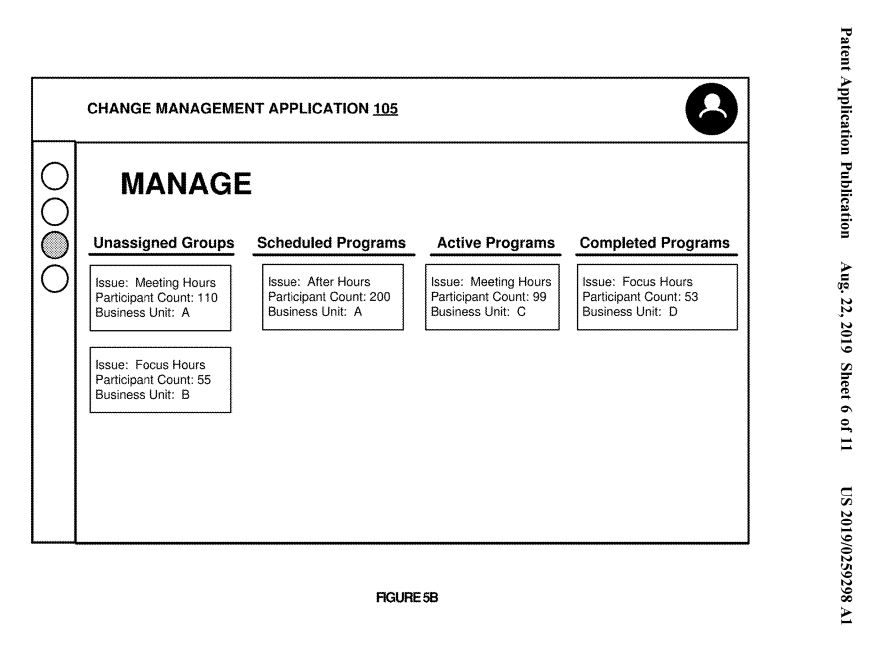
Remember when Microsoft was criticized for enabling "workplace surveillance" over "productivity scores" in its Microsoft 365 office software which gave managers highly detailed profiles of each individual employee's activity. Long-time Slashdot reader theodp writes: The Microsoft 365 Productivity Score apparently has roots in another Microsoft patent application for Systems, Methods, and Software for Implementing a Behavior Change Management Program, which also lays out plans for as yet unimplemented features to automatically schedule hundreds of employees for months of productivity re-education, including preventing employees from scheduling meetings with others if the service deems it counter-productive. So, could the HAL 9000's "I'm sorry Dave, I'm afraid I can't do that" be considered prior art?
But Microsoft "has even bigger ideas for using technology to monitor workers in the interest of maximizing organizational productivity," reports GeekWire: Newly surfaced Microsoft patent filings describe a system for deriving and predicting "overall quality scores" for meetings using data such as body language, facial expressions, room temperature, time of day, and number of people in the meeting. The system uses cameras, sensors, and software tools to determine, for example, "how much a participant contributes to a meeting vs performing other tasks (e.g., texting, checking email, browsing the Internet)."

The "meeting insight computing system" would then predict the likelihood that a group will hold a high-quality meeting. It would flag potential challenges when an organizer is setting the meeting up, and recommend alternative venues, times, or people to include in the meeting, for example... A patent application made public Nov. 12 notes, "many organizations are plagued by overly long, poorly attended, and recurring meetings that could be modified and/or avoided if more information regarding meeting quality was available." The approach would apply to in-person and virtual meetings, and hybrids of the two...

The filings do not detail any potential privacy safeguards. A Microsoft spokesperson declined to comment on the patent filings in response to GeekWire's inquiry. To be sure, patents are not products, and there's no sign yet that Microsoft plans to roll out this hypothetical system. Microsoft has established an internal artificial intelligence ethics office and a companywide committee to ensure that its AI products live by its principles of responsible AI, including transparency and privacy. However, the filings are a window into the ideas floating around inside Microsoft, and they're consistent with the direction the company is already heading.

Transportation

Will Tesla Update Bring Remote Access To Car Cameras? (electrek.co) 59

"Tesla's Sentry Mode is about to bring things to a whole new level by enabling Tesla owners to remotely see what their cars can see through Autopilot cameras," claims Electrek — citing a Twitter user named green "who has been revealing new Tesla features found in software updates."

"It's not certain when the live camera update would arrive, provided it's not scrapped," writes Engadget, adding "Elon Musk has been teasing a 'hot' holiday software release, but 'green' warned that it might not make that release..."

Some background from Electrek: For a while now, Tesla has been talking about better integrating its Tesla Sentry Mode feature into its mobile app. Sentry Mode is an integrated surveillance system inside Tesla's vehicles using the Autopilot cameras around the car and it has been changing the game when it comes to vandalizing parked cars. On several occasions, Sentry Mode videos went viral, and the vandals turned themselves in after online pressure. In other cases, video evidence helped police identify and find the vandals.

The feature was built on top of "TeslaCam," a previously released integrated dashcam system with similar capability as Sentry mode, but used when someone is inside the car. TeslaCam helped several Tesla owners with insurance claims by proving that they weren't at fault in some accidents captured by the integrated dashcam system. In order to activate the TeslaCam and Sentry Mode features, owners have to plug a storage device, thumb drive, or SSD inside their Tesla and activate the features in the settings...

Tesla owners can already have an extensive look at the status of their vehicles, including the doors open or close, same for windows, charge port, and more. Now they are going to be able to see around their vehicles even if no Sentry Mode event has been activated.

That's only if the update is actually released. How do Slashdot's readers feel about the possibility of this feature?

Does the world change when Tesla owners can remotely access their cars' cameras?
Government

What Happened After Silicon Valley Tried to Make Telecommuting Permanent (eastbaytimes.com) 114

California's state air quality mandates require each region to have a feasible plan for a 19% reduction in emissions by 2035. But "after a barrage of criticism from Silicon Valley businesses and Bay Area mayors, Metropolitan Transportation Commission planners have backed off a requirement to have employees from big companies work from home three days a week," reports the Bay Area News Group.

Instead a compromise plan approved unanimously by commissioners last week "calls for big companies to have 60% of their employees take sustainable commutes — by transit, bike or carpooling — by 2035."

Lawmakers, mayors and the business community railed against the remote work mandate, saying it would undercut the Bay Area's economy and encourage large companies to re-locate to cheaper regions. Transit supporters said work-from-home requirements would cut train and bus use without clear proof it would reduce the mileage of vehicle trips and emissions. The new proposal calls for no more than 40 percent of a company's workforce to commute by auto on an average workday by 2035. Farms and employers with fewer than 50 workers would be exempt.

The plan encourages companies to subsidize transit passes, bikes, on-site employee housing, and commuter shuttles, as well as helping workers afford housing in walkable, transit-rich communities. Many large tech companies like Google and Facebook already provide shuttles and subsidize transit for their workers. It also suggests companies discourage workers from single-vehicle commutes by reducing parking spaces and raising parking fees, compressing work schedules and eliminating personal desks in favor of shared work spaces.

The new proposal was designed with input from state lawmakers, the mayors of San Francisco and San Jose, county supervisors, and officials from the tech industry and transit groups, MTC commissioner Nick Josefowitz said. "This is a much more effective policy," said Josefowitz, chief of policy at the regional think tank SPUR. "This is figuring out how to do it better with everybody at the table." Gwen Litvak of the business coalition Bay Area Council said the work-from-home mandate would have hurt urban centers and businesses. "The compromise will help revitalize downtowns, and gives business critical flexibility to have workers carpool, use public transit, ride bikes or walk, or even work remotely, but by their own choice," she said.

San Jose Mayor Sam Liccardo said the revisions better reflect how his city is evolving — from a suburban, car-centric culture to a city focused on developing a dense commercial and residential core supported by a robust transit network... Liccardo said part of Silicon Valley's success springs from having talented employees working side-by-side, exchanging ideas and innovations. Remote work reduces some creative energy.

"We cannot impose mandates that contradict the laws of human nature and the laws of creative industry," he said.

United States

America's Top Court Strikes Down Covid-19 Restriction On Religious Groups (cnn.com) 465

DevNull127 writes: Earlier this year the governor's order had "restricted the size of religious gatherings in certain areas of New York where infection rates were climbing," reports the New York Times. But Wednesday night (in a close 5 to 4 decision) America's highest court ruled against the governor — and in favor of two religious organizations challenging him.

"[T]hey tell us without contradiction that they have complied with all public health guidance, have implemented additional precautionary measures, and have operated at 25% or 33% capacity for months without a single outbreak," the ruling points out.

CNN notes that the court's majority believed that the governor's enjoined regulations were "'far more restrictive than any Covid-related regulations that have previously come before the court, much tighter than those adopted by many other jurisdictions hard hit by the pandemic, and far more severe than has been shown to be required to prevent the spread of the virus' at the religious services in question."

The Times concludes that "If unconstrained religious observance and public safety were sometimes at odds, as the governor and other public officials maintained, the court ruled that religious freedom should win out."
Jeffrey D. Sachs, a professor and director of the Center for Sustainable Development at Columbia University, argues the court's ruling "proved the dangers of scientifically illiterate judges overturning government decisions that were based on scientific evidence."
Bitcoin

Chinese Police Have Seized $4.2 Billion Cryptos from PlusToken Ponzi Crackdown (theblockcrypto.com) 81

Crypto assets worth more than $4.2 billion have been seized by Chinese police during the massive PlusToken Ponzi scheme crackdown, according to a new court ruling. From a report: In a November 19 judgment made public on Thursday, the Jiangsu Yancheng Intermediate People's Court has detailed the breakdown for the first time of all the crypto assets seized by Chinese police related to the PlusToken case. A total of 194,775 BTC, 833,083 ETH, 1.4 million LTC, 27.6 million EOS, 74,167 DASH, 487 million XRP, 6 billion DOGE, 79,581 BCH, and 213,724 USDT have been seized by Chinese law enforcement from seven convicts during the crackdown. These assets, at today's prices, are worth over $4.2 billion in total. As part of the ruling, the court said "the seized digital currencies will be processed pursuant to laws and the proceeds and gains will be forfeited to the national treasury." However, the Yancheng Intermediate People's Court doesn't elaborate on how much of the seized crypto assets have been or will be "processed" or via what method exactly. The PlusToken criminal case was initially ruled on September 22 by a lower-level district court in the city of Yancheng in China's Jiangsu province.
Privacy

A Hacker is Selling Access To the Email Accounts of Hundreds of C-Level Executives (zdnet.com) 40

A threat actor is currently selling passwords for the email accounts of hundreds of C-level executives at companies across the world. From a report: The data is being sold on a closed-access underground forum for Russian-speaking hackers named Exploit.in, ZDNet has learned this week. The threat actor is selling email and password combinations for Office 365 and Microsoft accounts, which he claims are owned by high-level executives occupying functions such as: CEO, COO, CFO, CMO, CTO, President, VP, Exec Assistant, Finance Manager, Accountant, and Director. Access to any of these accounts is sold for prices ranging from $100 to $1,500, depending on the company size and user's role.
Microsoft

Microsoft Productivity Score Feature Criticised as Workplace Surveillance (theguardian.com) 60

Microsoft has been criticised for enabling "workplace surveillance" after privacy campaigners warned that the company's "productivity score" feature allows managers to use Microsoft 365 to track their employees' activity at an individual level. From a report: The tools, first released in 2019, are designed to "provide you visibility into how your organisation works," according to a Microsoft blogpost, and aggregate information about everything from email use to network connectivity into a headline percentage for office productivity. But by default, reports also let managers drill down into data on individual employees, to find those who participate less in group chat conversations, send fewer emails, or fail to collaborate in shared documents. "This is so problematic at many levels," tweeted the Austrian researcher Wolfie Christl, who raised alarm about the feature. "Employers are increasingly exploiting metadata logged by software and devices for performance analytics and algorithmic control," Christl added. "MS is providing the tools for it. Practices we know from software development (and factories and call centres) are expanded to all white-collar work."
Books

Cambridge University Says Darwin's Iconic Notebooks Were Stolen (nbcnews.com) 52

An anonymous reader quotes a report from NBC News: Two notebooks written by the famed British naturalist Charles Darwin in 1837 and missing for years may have been stolen from the Cambridge University Library, according to curators who launched a public appeal Tuesday for information. The notebooks, estimated to be worth millions of dollars, include Darwin's celebrated "Tree of Life" sketch that the 19th-century scientist used to illustrate early ideas about evolution. Officials at the Cambridge University Library say the two notebooks have been missing since 2001, and it's now thought that they were stolen.

"I am heartbroken that the location of these Darwin notebooks, including Darwin's iconic 'Tree of Life' drawing, is currently unknown, but we're determined to do everything possible to discover what happened and will leave no stone unturned during this process," Jessica Gardner, the university librarian and director of library services, said in a statement. The lost manuscripts were initially thought to have been misplaced in the university's enormous archives, which house roughly 10 million books, maps and other objects. But an exhaustive search initiated at the start of 2020 -- the "largest search in the library's history," according to Gardner -- failed to turn up the notebooks and they are now being reported as stolen. Cambridge University officials said a police investigation is underway and the notebooks have been added to Interpol's database of stolen artworks.

Security

hCaptcha Runs On 15% Of the Internet (hcaptcha.com) 66

In a blog post, hCaptcha announced that its bot detector is running on about 15% of the internet, adding they they "took most of this market share directly from Google reCAPTCHA." From the post: Competing with Google and other Big Tech companies seems like a tall order: their monopolistic market power, platform effects and army of highly paid developers are generally considered too powerful to tackle for anyone but other tech giants such as Facebook or Amazon. Our story shows that it doesn't have to be that way -- you can beat Big Tech by focussing on privacy. Consider Google reCAPTCHA, which consumes enormous amounts of behavioral data to determine whether web users are legitimate humans or bots. At hCaptcha, we have deliberately taken a very different approach, using privacy-preserving machine learning techniques to identify typical bot behaviors at high accuracy, all while consuming and storing as little data as possible.

Google is an ad company, and their security products look very much like their ad products: they track user behavior on every page of a website and across the web. We designed hCaptcha to be as privacy-friendly as possible from day one. This led to a completely different approach to the problem. As it turns out, tracking users across the web and tying their web history to their identity is completely unnecessary for achieving good security. The many companies that have switched over to hCaptcha often report equal or better performance in bot detection and mitigation despite our privacy focus.

A growing number of critics have pointed out that Google's disregard for user privacy should concern customers looking to protect their websites and apps. At the same time, stopping bots from accessing publisher sites can reveal ad fraud, pitting Google's reCAPTCHA product directly against their ad business, which produces over 80% of their revenue. Every bot Google detects should be earning zero ad dollars. Google's company incentives are thus poorly aligned with the users of their security services, and this may be one explanation for the poor performance of their reCAPTCHA security offering.

Businesses

Struggling Electric Jet Startup Zunum Sues Boeing For Fraud and Misuse of Trade Secrets (theverge.com) 23

Kirkland, Washington-based aviation startup Zunum Aero filed a lawsuit this week accusing Boeing of fraud, technology theft, breach of contract, and misappropriation of trade secrets. The company, which had received millions of dollars from the venture arms of Boeing and JetBlue, said it would be ready to fly its 12-seat hybrid electric jets by 2022. Instead, it ran out of cash in 2018, forcing it to lay off nearly all of its employees and vacate its headquarters. The Verge reports: Zunum said that Boeing "colluded with other key aerospace manufacturers and funders" to sabotage its efforts to raise additional cash and tried to poach Zunum's engineers during the process. The startup claims that Boeing saw its superior technology and potential to disrupt air travel as a threat to its own dominance in the aviation world and sought to undermine it. Using its due diligence as an investor as subtext, Zunum said Boeing gained access to its business plan and proprietary technology, and "exploited" Zunum for its own benefit.

"Boeing saw an innovative venture, with a dramatically improved path to the future, and presented itself as interested in investing and partnering with Zunum," the company claims in court filings. "But instead, Boeing stole Zunum's technology and intentionally hobbled the upstart entrant in order to maintain its dominant position in commercial aviation by stifling competition." It's rare that a startup would sue one of its investors after failing to deliver on its promises. But Zunum said its setbacks weren't because of bad technology or a faulty business plan. Rather, the company claims it was sabotaged by Boeing, which misused its position as an investor to pillage its talent and patents before eventually scuttling the company's ability to continue to raise money.

Zunum also names HorizonX, Boeing's venture capital arm, and French engine supplier Safran as co-defendants. The company is seeking compensatory and punitive damages. A spokesperson for Boeing said the lawsuit was without merit and that the company would "vigorously" contest it in court.

Privacy

IRS Could Search Warrantless Location Database Over 10,000 Times (vice.com) 16

An anonymous reader quotes a report from Motherboard: The IRS was able to query a database of location data quietly harvested from ordinary smartphone apps over 10,000 times, according to a copy of the contract between IRS and the data provider obtained by Motherboard. The document provides more insight into what exactly the IRS wanted to do with a tool purchased from Venntel, a government contractor that sells clients access to a database of smartphone movements. The Inspector General is currently investigating the IRS for using the data without a warrant to try to track the location of Americans. "This contract makes clear that the IRS intended to use Venntel's spying tool to identify specific smartphone users using data collected by apps and sold onwards to shady data brokers. The IRS would have needed a warrant to obtain this kind of sensitive information from AT&T or Google," Senator Ron Wyden told Motherboard in a statement after reviewing the contract. [...]

One of the new documents says Venntel sources the location information from its "advertising analytics network and other sources." Venntel is a subsidiary of advertising firm Gravy Analytics. The data is "global," according to a document obtained from CBP. Venntel then packages that data into a user interface and sells access to government agencies. A former Venntel worker previously told Motherboard that customers can use the product to search a specific area to see which devices were there, or follow a particular device across time. Venntel provides its own pseudonymous ID to each device, but the former worker said users could try to identify specific people. The new documents say that the IRS' purchase of an annual Venntel subscription granted the agency 12,000 queries of the dataset per year.

"In support of Internal Revenue Service (IRS) Criminal Investigation's (CI) law enforcement investigative mission, the Cyber Crimes Unit (CCU) requires one (1) Venntel Mobile Intelligence web-based subscription," one of the documents reads. "This allows tracing and pattern-of-life analysis on locations of interesting criminal investigations, allowing investigators to trace locations of mobile devices even if a target is using anonymizing technologies like a proxy server, which is common in cyber investigations," it adds.

Security

2FA Bypass Discovered In Web Hosting Software cPanel (zdnet.com) 9

An anonymous reader quotes a report from ZDNet: Security researchers have discovered a major security flaw in cPanel, a popular software suite used by web hosting companies to manage websites for their customers. The bug, discovered by security researchers from Digital Defense, allows attackers to bypass two-factor authentication (2FA) for cPanel accounts. These accounts are used by website owners to access and manage their websites and underlying server settings. Access to these accounts is critical, as once compromised, they grant threat actors full control over a victim's site.

On its website, cPanel boasts that its software is currently used by hundreds of web hosting companies to manage more than 70 million domains across the world. But in a press release today, Digital Defense says that the 2FA implementation on older cPanel & WebHost Manager (WHM) software was vulnerable to brute-force attacks that allowed threat actors to guess URL parameters and bypass 2FA -- if 2FA was enabled for an account. While brute-forcing attacks, in general, usually take hours or days to execute, in this particular case, the attack required only a few minutes, Digital Defense said today. Exploiting this bug also requires that attackers have valid credentials for a targeted account, but these can be obtained from phishing the website owner. The good news is that Digital Defense has privately reported the bug, tracked as SEC-575, to the cPanel team, which has already released patches last week.

Nintendo

Nintendo Sues More Hack Sellers, 'a Worsening International Problem' (polygon.com) 41

Nintendo of America has filed a lawsuit against an Amazon Nintendo Switch hack reseller -- the sort of litigation it's taken on in similar cases in the past. Nintendo's lawyers allege the Amazon seller, Le Hoang Minh, circumvents Nintendo's copyright measures in selling an RCM Loader, used to "jailbreak" the Nintendo Switch. From a report: The lawsuit was filed in a Seattle court last week, according to court documents obtained by Polygon. In the lawsuit, Nintendo outlines what it calls a "serious, worsening international problem" with video game software piracy. It details Nintendo's security systems, and how the RCM Loaders bypass those systems. The RCM Loader (which is essentially a USB device that plugs into the Nintendo Switch) allows the user to play so-called "pirated" or unauthorized games. According to the lawsuit, Nintendo sent a DMCA notice to the seller, to which a counterclaim was issued. Because of the counterclaim, Amazon was required to relist the RCM Loader, unless Nintendo filed an infringement lawsuit. And that's what it did. The company is looking for the courts to stop the seller, and award it $2,500 in damages for each infringement.
Google

Google Ordered To Hand Over Emails in $600 Million Divorce Battle (ft.com) 33

A US court has ordered Google to hand over the personal emails of the son of a Russian oligarch as part of a bitter $601 million divorce case. From a report [Editor's note: the link may be paywalled; alternative source]: Judge Virginia DeMarchi in California told the US tech group to surrender Temur Akhmedov's emails for use as evidence in a lawsuit brought by his mother, Tatiana Akhmedova, the wife of an ally of President Vladimir Putin. Ms Akhmedova has gone to court in the US and the UK in an attempt to force her ex-husband, Farkhad Akhmedov, to pay the world's largest-ever divorce settlement. Google said the order was a breach of its customer's privacy. The divorce case, which is being funded by litigation financier Burford Capital, has led to a legal battle over assets including a helicopter, a private jet and a superyacht called the Luna that used to belong to Chelsea Football Club owner Roman Abramovich. Google sought to block the order to give up the emails this week on the basis that to do so would infringe Mr Akhmedov's right to privacy because he had not given consent to share them. Ms DeMarchi said Google's concern for the "privacy and security of its account holders' communications" was "commendable" but ruled the request did not breach the US Stored Communications Act, which governs voluntary and compelled disclosure of emails. The information from the emails will be used to learn whether Temur assisted his father in the fraudulent transfer of assets, and if so, to win a judgment against him, Tatiana Akhmedova said in a filing.
Crime

Three Members of TMT Cybercrime Group Arrested in Nigeria (zdnet.com) 15

Three Nigerians suspected of being part of a cybercrime group that targeted tens of thousands of victims around the world have been arrested today in Lagos, Nigeria's capital, Interpol reported. From a report: In a report disclosing its involvement in the investigation, security firm Group-IB said the three suspects are members of a cybercrime group they have been tracking since 2019 and which they have been tracking under the codename of TMT. Group-IB said the group primarily operated by sending out mass email spam campaigns containing files laced with malware. To send their email spam, the group used the Gammadyne Mailer and Turbo-Mailer email automation tools and then relied on MailChimp to track if a recipient victim opened their messages. The file attachments were laced with various strains of malware that granted hackers access to infected computers from where they focused on stealing credentials from browsers, email, and FTP clients.
Patents

Vestager Seeks Patents Overhaul Amid Court Fights Over Cars (bloomberg.com) 15

The European Union will seek to overhaul the system for key patents such as those that have fueled legal battles between car makers and technology companies, the EU's technology chief said Wednesday. From a report: Margrethe Vestager promised that regulators will weigh reforms to improve the framework in place for so-called standard-essential patents and work on industry-led initiatives "to reduce frictions and litigation." The EU move could help avoid repeats of lengthy legal battles such as Nokia Oyj's effort to get Daimler AG to pay more for mobile technology used in cars. While Daimler wants the underlying patents be licensed to its various component suppliers, Nokia wants to charge per car at a much higher price. Companies often seek court help to determine whether certain technology patents are valid and how much should be paid for licensing technology seen as essential for an industry. The EU has frequently been asked to weigh in on how much is fair for key technology. "There's quite a lot of litigation back and forth and in the short-term we would want to push for industry to figure out how to set up foras to enable discussions and mediation so that maybe to a bigger degree it can be solved out of court," Vestager said. The current system to set up so-called standard essential patents deemed key to certain technology "is not very transparent," she said. "This is why we will consider a very close consultation with anyone involved whether we should set up a third-party essential 'reality check' so someone outside of your business" can rule on whether a patent is really important or not.

Slashdot Top Deals