Space

Study Casts Doubt on Potential For Life on Jupiter's Moon Europa (nature.com) 22

Jupiter's moon Europa is on the short list of places in our solar system seen as promising in the search for life beyond Earth, with a large subsurface ocean thought to be hidden under an outer shell of ice. But new research is raising questions about whether Europa in fact has what it takes for habitability. Reuters: The study assessed the potential on Europa's ocean bottom for tectonic and volcanic activity, which on Earth facilitate interactions between rock and seawater that generate essential nutrients and chemical energy for life. After modeling Europa's conditions, the researchers concluded that its rocky seafloor is likely mechanically too strong to allow such activity.

The researchers considered factors including Europa's size, the makeup of its rocky core and the gravitational forces exerted by Jupiter, the solar system's largest planet. Their evaluation that there probably is little to no active faulting at Europa's seafloor suggests this moon is barren of life.

"On Earth, tectonic activity such as fracturing and faulting exposes fresh rock to the environment where chemical reactions, principally involving water, generate chemicals such as methane that microbial life can use," said planetary scientist Paul Byrne of Washington University in St. Louis, lead author of the study published on Tuesday in the journal Nature Communications. "Without such activity, those reactions are harder to establish and sustain, making Europa's seafloor a challenging environment for life," Byrne added.

Communications

Net Neutrality Was Back, Until It Wasn't (theverge.com) 8

The fight over net neutrality saw another turbulent year in 2025, as federal protections that seemed poised for a comeback in 2024 were first struck down by a court and then preemptively removed by the Trump administration's FCC without a chance for public comment.

The removal, The Verge summarizes in a report, was part of Chairman Brendan Carr's "Delete, Delete, Delete" initiative targeting what the agency deems unnecessary regulations. Federal net neutrality rules have now been on and off for 15 years, passing under Obama in 2010, returning in 2015, getting overturned in 2017, and briefly revived in 2024 before courts struck them down again.

Matt Wood, vice president of policy and general counsel at nonprofit Free Press, told The Verge that ISPs often feel little financial impact from these rules. "A lot of their complaints about the supposed 'burdens' from these rules are really just ideological in nature," Wood said. States have filled the void.

California's 2018 law remains the nation's gold standard, and Maine passed a bipartisan bill in June. John Bergmayer, legal director at Public Knowledge, said state-level laws and the threat of new ones "has kept some of the worst outcomes in check."

The National Telecommunications and Information Administration is now pressuring states to exempt ISPs from net neutrality laws to remain eligible for broadband infrastructure funding. Chao Jun Liu of the Electronic Frontier Foundation summed up the year's pattern: "ISPs just want to do whatever they want to do with no limits and nobody telling them how to do it."
Government

Denmark's Main Postal Carrier Ends Letter Delivery (nytimes.com) 41

PostNord is ending letter delivery in Denmark after a 90%+ collapse in mail volume. It marks the first known case of a national postal carrier abandoning letters entirely -- a symbolic milestone of a fully digitized society that's sparking nostalgia even among people who stopped sending mail years ago. The New York Times reports: Denmark has had a postal service for more than 400 years. But a steep decline in its use has led the Nordic country's longtime postal carrier to stop letter deliveries entirely, a change taking effect on Tuesday.

Danes have seen it coming for months: The carrier, PostNord, has been removing its red mailboxes, once a ubiquitous public fixture. The disappearance of the mailboxes is "what actually made people emotional," said Julia Lahme, a trend researcher and the director of Lahme, a Danish communications agency, "even though most of them hadn't sent a letter in 18 months."

Letter writing in the country has declined by more than 90 percent since 2000, according to PostNord, which is owned jointly by the Danish and Swedish governments. Next year, in Denmark, it will only deliver packages, although in Sweden it will continue to deliver letters.

The change comes partly as a result of a drop-off in government mail. Denmark is one of the world's most digitized countries. Only 250,000 people, or less than 5 percent of the population, still receive their official communications in the mail. "People simply do not rely on physical letters the way they used to," Andreas Brethvad, the communications director of PostNord Denmark, said in an emailed statement. He said that because nine in 10 Danes shop online each month, the change "is about keeping up with times to meet the demands of society. It's a natural evolution."
The report notes that snail mail lovers will still be able to send and receive letters through Dao, a private company. "While some Danes are quietly mourning a service that, for the most part, they had largely stopped using, the transition feels like a sign of the times," reports the Times.
The Military

Military Planners Dread the Arctic, 'Where Drones Drop Dead and GPS Goes Haywire' (msn.com) 117

An anonymous reader shared this report from the Wall Street Journal: Sending drones and robots into battle, rather than humans, has become a tenet of modern warfare. Nowhere does that make more sense than in the frozen expanses of the Arctic. But the closer you get to the North Pole, the less useful cutting-edge technology becomes. Magnetic storms distort satellite signals; frigid temperatures drain batteries or freeze equipment in minutes; navigation systems lack reference points on snowfields.

During a seven-nation polar exercise in Canada earlier this year to test equipment worth millions of dollars, the U.S. military's all-terrain arctic vehicles broke down after 30 minutes because hydraulic fluids congealed in the cold. Swedish soldiers participating in the exercise were handed $20,000 night-vision optics that broke because the aluminum in the goggles couldn't handle the minus 40 degree Fahrenheit conditions....

An arctic conflict would force war planners back to basics. Extreme cold makes the most common components brittle. Low temperatures alter the physical properties of rubber, causing seals to lose their elasticity and leak. Traces of water or humidity freeze into ice crystals that can scratch pumps and create blockages. Wires should be insulated with silicone rather than PVC, which can crack. Oil and other lubricants thicken and congeal. In most standard hydraulic systems, fluid becomes syrupy and can affect everything from aircraft controls to missile launchers and radar masts. A single freeze-up can knock out an entire weapons platform or immobilize a convoy.

Even the Aurora Borealis interferes with radio communications and satellite-navigation systems, according to the article.
Space

Is Russia Developing an Anti-Satellite Weapon to Target Starlink? (apnews.com) 140

An anonymous reader shared this report from the Associated Press: Two NATO-nation intelligence services suspect Russia is developing a new anti-satellite weapon to target Elon Musk's Starlink constellation with destructive orbiting clouds of shrapnel, with the aim of reining in Western space superiority that has helped Ukraine on the battlefield. Intelligence findings seen by The Associated Press say the so-called "zone-effect" weapon would seek to flood Starlink orbits with hundreds of thousands of high-density pellets, potentially disabling multiple satellites at once but also risking catastrophic collateral damage to other orbiting systems.

Analysts who haven't seen the findings say they doubt such a weapon could work without causing uncontrollable chaos in space for companies and countries, including Russia and its ally China, that rely on thousands of orbiting satellites for communications, defense and other vital needs. Such repercussions, including risks to its own space systems, could steer Moscow away from deploying or using such a weapon, analysts said. "I don't buy it. Like, I really don't," said Victoria Samson, a space-security specialist at the Secure World Foundation who leads the Colorado-based nongovernmental organization's annual study of anti-satellite systems. "I would be very surprised, frankly, if they were to do something like that." [Later they suggested the research might just be experimental.]

But the commander of the Canadian military's Space Division, Brig. Gen. Christopher Horner, said such Russian work cannot be ruled out in light of previous U.S. allegations that Russia also has been pursuing an indiscriminate nuclear, space-based weapon. "I can't say I've been briefed on that type of system. But it's not implausible," he said... The French military's Space Command said in a statement to the AP that it could not comment on the findings but said, "We can inform you that Russia has, in recent years, been multiplying irresponsible, dangerous, and even hostile actions in space."

The article also points out that this month Russia "said it has fielded a new ground-based missile system, the S-500, which is capable of hitting low-orbit targets..."
Windows

Microsoft Says It's Not Planning To Use AI To Rewrite Windows From C To Rust 41

Microsoft has denied any plans to rewrite Windows 11 using AI and Rust after a LinkedIn post from one of its top-level engineers sparked a wave of online backlash by claiming the company's goal was to "eliminate every line of C and C++ from Microsoft by 2030."

Galen Hunt, a principal software engineer responsible for several large-scale research projects at Microsoft, made the claim in what was originally a hiring post for his team. His original wording described a "North Star" of "1 engineer, 1 month, 1 million lines of code" and outlined a strategy to "combine AI and Algorithms to rewrite Microsoft's largest codebases." The repeated use of "our" in the post led many to interpret it as an official company direction rather than a personal research ambition.

Frank X. Shaw, Microsoft's head of communications, told Windows Latest that the company has no such plans. Hunt subsequently edited his LinkedIn post to clarify that "Windows is NOT being rewritten in Rust with AI" and that his team's work is a research project focused on building technology to enable language-to-language migration. He characterized the reaction as "speculative reading between the lines."
Programming

What Might Adding Emojis and Pictures To Text Programming Languages Look Like? 83

theodp writes: We all mix pictures, emojis, and text freely in our communications. So why not in our code? That's the premise of "Fun With Python and Emoji: What Might Adding Pictures to Text Programming Languages Look Like?" (two-image Bluesky explainer; full slides), which takes a look at what mixing emoji with Python and SQL might look like. A GitHub repo includes a Google Colab-ready Python notebook proof of concept that does rudimentary emoji-to-text translation via an IPython input transformer.

So, in the Golden Age of AI -- some 60+ years after Kenneth Iverson introduced the chock-full-of-symbols APL -- are valid technical reasons still keeping symbols and pictures out of code, or is their absence more of a programming dogma thing?
The Courts

Judge Blocks Texas App Store Age Verification Law (theverge.com) 43

A federal judge blocked Texas' app store age-verification law, ruling it likely violates the First Amendment by forcing platforms to gate speech and collect data in an overly broad way. The law was set to go into effect on January 1, 2026. The Verge reports: In an order granting a preliminary injunction on the Texas App Store Accountability Act (SB 2420), Judge Robert Pitman wrote that the statute "is akin to a law that would require every bookstore to verify the age of every customer at the door and, for minors, require parental consent before the child or teen could enter and again when they try to purchase a book." Pitman has not yet ruled on the merits of the case, but his decision to grant the preliminary injunction means he believes its defenders are unlikely to prevail in court.

Pitman found that the highest level of scrutiny must be applied to evaluate the law under the First Amendment, which means the state must prove the law is "the least restrictive means of achieving a compelling state interest." The judge found this is not the case and that it wouldn't even survive intermediate scrutiny, because Texas has so far failed to prove that its goals are connected to its methods. Since Texas already has a law requiring age verification for porn sites, Pitman said that "only in the vast minority of applications would SB 2420 have a constitutional application to unprotected speech not addressed by other laws." Though Pitman acknowledged the importance of safeguarding kids online, he added, "the means to achieve that end must be consistent with the First Amendment. However compelling the policy concerns, and however widespread the agreement that the issue must be addressed, the Court remains bound by the rule of law."
"The Texas App Store Accountability Act is the first among a series of similar state laws to face a legal challenge, making the ruling especially significant, as Congress considers a version of the statute," notes The Verge. "The laws, versions of which also passed in Utah and Louisiana, aim to impose age verification standards at the app store level, making companies like Apple and Google responsible for transmitting signals about users' ages to app developers to block users from age-inappropriate experiences."

"The state can still appeal the ruling with the Fifth Circuit Court of Appeals, which has a history of reversing blocks on internet regulations."
Businesses

State of Play: Who Holds the Power in the Video Games Industry in 2025? (theguardian.com) 25

The video games industry in 2025 finds itself caught between the familiar forces of consolidation and job losses that have plagued creative industries, and a newer development: governments and the ultra-wealthy have begun treating games as tools of political influence. Saudi Arabia's Public Investment Fund closed a $55 billion deal for EA this year and acquired Niantic, the makers of Pokemon Go, in March.

Microsoft's 2023 acquisition of Activision already signaled the direction of travel. The workforce has borne the costs of this consolidation. More than 5,000 jobs have been lost in the industry this year, and several studios have shuttered, including Monolith Productions. The instability has pushed unions into greater prominence: United Videogame Workers formed in the US and Canada in March as part of the Communications Workers of America, and the firing of 30 staff from Rockstar Games in the UK brought the IWGB Game Workers Union into the spotlight.

Meanwhile, the Trump administration has posted AI-generated images of the president as Halo's Master Chief and used Pokemon and Halo memes to recruit for ICE.
United States

The U.S. Could Ban Chinese-Made Drones Used By Police Departments (msn.com) 76

Tuesday the White House faces a deadline to decide "whether Chinese drone maker DJI Technologies poses a national security threat," reports Bloomberg. But their article notes it's "a decision with the potential to ground thousands of machines deployed by police and fire departments across the US."

One person making the case against the drones is Mike Nathe, a North Dakota Republican state representative described by the Post as "at the forefront of a nationwide campaign sounding alarms about the Made-in-China aircraft." Nathe tells them that "People do not realize the security issue with these drones, the amount of information that's being funneled back to China on a daily basis." The president already signed anexecutive orderin June targeting "foreign control or exploitation" of America's drone supply chain. That came after Congress mandated a review to determine whether DJI deserves inclusion in a federal register of companies believed to endanger national security. If DJI doesn't get a clean bill of health for Christmas, it could join Huawei Technologies Co. Ltd. and ZTE Corp.on that Federal Communications Commission list. The designation would give the Trump administration authority to prevent new domestic sales or even impose a flight ban, affecting public agencies from New York to North Dakota to Nevada...

The fleet used by public safety agencies nationwide exceeds about 25,000 aircraft, said Chris Fink, founder of Unmanned Vehicle Technologies LLC, a Fayetteville, Arkansas-based firm that advises law-enforcement clients. The overwhelming majority of those drones — called uncrewed aerial vehicles, or UAVs, in industry parlance — comes from China, said Jon Beal, president of theLaw Enforcement Drone Association, a training and advocacy group that counts DJI and some US competitors as corporate sponsors...

Currently, at least half a dozen states havetargeted DJIand other Chinese-manufactured drones, including restrictions in Arkansas, Mississippi and Tennessee. A Nevada law prohibiting public agencies from using Chinese drones took effect in January... Legislators also took up the cause in Connecticut, which passed a law this year preventing public offices from using Chinese drones. Supporters said they're worried about these eyes in the skies being used for spying. "We're kind of sitting ducks," said Bob Duff, the Democratic majority leader in the state senate who promoted the legislation. "They are designed to infiltrate systems even when the users don't think that they will."

One North Dakota sheriff's department complains U.S.-made drones are "at least double and triple the price out of the gate," according to the article, which adds that public safety officials "say it's difficult to find domestic alternatives that match DJI in price and performance."

And DJI "wants an extension on the security review," according to the article, "saying Tuesday is too soon to make a conclusion."
United States

Military Satellites Now Maneuver, Watch Each Other, and Monitor Signals and Data (msn.com) 15

An anonymous reader shared this report from the Washington Post. (Alternate URL here): The American patrol satellite had the targets in its sights: two recently launched Chinese spacecraft flying through one of the most sensitive neighborhoods in space. Like any good tactical fighter, the American spacecraft, known as USA 270, approached from behind, so that the sun would be at its back, illuminating the quarry.

But then one of the Chinese satellites countered by slowing down. As USA 270 zipped by, the Chinese satellite dropped in behind its American pursuer, like Maverick's signature "hit-the-brakes" move in the movie "Top Gun." The positions reversed, U.S. officials controlling their spacecraft from Earth were forced to plot their next move. The encounter some 22,000 miles above Earth in 2022 was never acknowledged publicly by the Pentagon or Beijing. Happening out of sight and little noticed except by space and defense specialists, this kind of orbital skirmishing has become so common that defense officials now refer to it as "dogfighting..."

Much of the "dogfighting" activity in space is simply for spying, defense analysts say, with specifics largely classified — snapping photos of each other's satellites to learn what kind of systems are on board and their capabilities. They monitor the signals and data emitted by satellites, listening to communications between space and the ground. Many can even jam those signals or interfere with orbiting craft that provide missile warnings, spy or relay critical information to troops... Traditionally, once a satellite was in orbit, it largely stayed on a fixed path, its operators reluctant to burn precious fuel. But now, the Pentagon and its adversaries, notably China and Russia, are launching satellites designed to fly in more dynamic ways that resemble aircraft — banking hard, slowing down, speeding up, even flying in tandem.

"Traditionally satellites weren't designed to fight, and they weren't designed to protect themselves in a fight," said Clinton Clark, the chief growth officer of ExoAnalytic Solutions, a company that monitors activity in space. "That is all changing now."

"Unlike dogfights between fighter jets, the jockeying-for-position encounters in orbit take place over several hours, even days," the article points out.

But it also notes that recently Germany's defense minister "complained about a Russian satellite that had been flying close to a commercial communications satellite used by the German military. 'They can jam, blind, manipulate or kinetically disrupt satellites,' he said."
Censorship

Russian Ban On Roblox Gaming Platform Sparks Rare Protest (reuters.com) 64

An anonymous reader quotes a report from Reuters: Several dozen people protested on Sunday in the Siberian city of Tomsk against Russia's ban on U.S. children's gaming platform Roblox, a rare show of public dissent as popular irritation over the ban gains some momentum. In wartime Russia, censorship is extensive: Moscow blocks or restricts social media platforms such as Snapchat, Facebook, Instagram, WhatsApp and YouTube while distributing its own narrative through a network of social media and Russian media. Russia's communications watchdog Roskomnadzor said on December 3 it had blocked Roblox because it was "rife with inappropriate content that can negatively impact the spiritual and moral development of children."

In Tomsk, 2,900 km (1,800 miles) east of Moscow, several dozen people braved the snow to hold up hand-drawn placards reading "Hands off Roblox" and "Roblox is the victim of the digital Iron Curtain" in Vladimir Vysotsky Park, according to photographs provided by an organizer of the protest. "Bans and blocks are all you are able to do," read one placard. The photographs showed about 25 people standing in a circle in the snow, holding up placards. In Russia, the ban on Roblox has triggered a debate over censorship, child safety in relation to technology and even the effectiveness of censorship in a digitalized world where children can bypass many bans in a few clicks.

Verizon

Verizon Refused To Unlock Man's iPhone, So He Sued the Carrier and Won (arstechnica.com) 46

A Kansas man who sued Verizon in small claims court after the carrier refused to unlock his iPhone has won his case, scoring a small but meaningful victory against a company that retroactively applied a policy change to deny his unlock request.

Patrick Roach bought a discounted iPhone 16e from Verizon's Straight Talk brand in February 2025, intending to pay for one month of service before switching the device to US Mobile. Under FCC rules dating back to a 2019 waiver, Verizon must unlock phones 60 days after activation on its network. Verizon refused to unlock the phone, citing a new policy implemented on April 1, 2025 requiring "60 days of paid active service."

Roach had purchased his device over a month before that policy took effect. Magistrate Judge Elizabeth Henry ruled in October 2025 that applying the changed terms to Roach's earlier purchase violated the Kansas Consumer Protection Act. The court ordered Verizon to refund Roach's $410.40 purchase price plus court costs. Roach had previously rejected a $600 settlement offer because it would have required him to sign a non-disclosure agreement. He estimated spending about 20 hours on the lawsuit but said "it wasn't about" the money.
United States

Repeal Section 230 and Its Platform Protections, Urges New Bipartisan US Bill (eff.org) 168

U.S. Senator Sheldon Whitehouse said Friday he was moving to file a bipartisan bill to repeal Section 230 of America's Communications Decency Act.

"The law prevents most civil suits against users or services that are based on what others say," explains an EFF blog post. "Experts argue that a repeal of Section 230 could kill free speech on the internet," writes LiveMint — though America's last two presidents both supported a repeal: During his first presidency, U.S. President Donald Trump called to repeal the law and signed an executive order attempting to curb some of its protections, though it was challenged in court. Subsequently, former President Joe Biden also voiced his opinion against the law.
An EFF blog post explains the case for Section 230: Congress passed this bipartisan legislation because it recognized that promoting more user speech online outweighed potential harms. When harmful speech takes place, it's the speaker that should be held responsible, not the service that hosts the speech... Without Section 230, the Internet is different. In Canada and Australia, courts have allowed operators of online discussion groups to be punished for things their users have said. That has reduced the amount of user speech online, particularly on controversial subjects. In non-democratic countries, governments can directly censor the internet, controlling the speech of platforms and users. If the law makes us liable for the speech of others, the biggest platforms would likely become locked-down and heavily censored. The next great websites and apps won't even get started, because they'll face overwhelming legal risk to host users' speech.
But "I strongly believe that Section 230 has long outlived its use," Senator Whitehouse said this week, saying Section 230 "a real vessel for evil that needs to come to an end." "The laws that Section 230 protect these big platforms from are very often laws that go back to the common law of England, that we inherited when this country was initially founded. I mean, these are long-lasting, well-tested, important legal constraints that have — they've met the test of time, not by the year or by the decade, but by the century.

"And yet because of this crazy Section 230, these ancient and highly respected doctrines just don't reach these people. And it really makes no sense, that if you're an internet platform you get treated one way; you do the exact same thing and you're a publisher, you get treated a completely different way.

"And so I think that the time has come.... It really makes no sense... [Testimony before the committee] shows how alone and stranded people are when they don't have the chance to even get justice. It's bad enough to have to live through the tragedy... But to be told by a law of Congress, you can't get justice because of the platform — not because the law is wrong, not because the rule is wrong, not because this is anything new — simply because the wrong type of entity created this harm."

Privacy

Chinese Whistleblower Living In US Is Being Hunted By Beijing With US Tech (go.com) 64

A former Chinese official who fled to the U.S. says Beijing has used advanced surveillance technology from U.S. companies to track, intimidate, and punish him and his family across borders. ABC News reports: Retired Chinese official Li Chuanliang was recuperating from cancer on a Korean resort island when he got an urgent call: Don't return to China, a friend warned. You're now a fugitive. Days later, a stranger snapped a photo of Li in a cafe. Terrified South Korea would send him back, Li fled, flew to the U.S. on a tourist visa and applied for asylum. But even there -- in New York, in California, deep in the Texas desert -- the Chinese government continued to hunt him down with the help of surveillance technology.

Li's communications were monitored, his assets seized and his movements followed in police databases. More than 40 friends and relatives -- including his pregnant daughter -- were identified and detained, even by tracking down their cab drivers through facial recognition software. Three former associates died in detention, and for months shadowy men Li believed to be Chinese operatives stalked him across continents, interviews and documents seen by The Associated Press show.

The Chinese government is using an increasingly powerful tool to cement its power at home and vastly amplify it abroad: Surveillance technology, much of it originating in the U.S., an AP investigation has found. Within China, this technology helped identify and punish almost 900,000 officials last year alone, nearly five times more than in 2012, according to state numbers. Beijing says it is cracking down on corruption, but critics charge that such technology is used in China and elsewhere to stifle dissent and exact retribution on perceived enemies.

Outside China, the same technology is being used to threaten wayward officials, along with dissidents and alleged criminals, under what authorities call Operations "Fox Hunt" and "Sky Net." The U.S. has criticized these overseas operations as a "threat" and an "affront to national sovereignty." More than 14,000 people, including some 3,000 officials, have been brought back to China from more than 120 countries through coercion, arrests and pressure on relatives, according to state information.

Businesses

Doom Studio id Software Forms 'Wall-To-Wall' Union (engadget.com) 32

id Software employees voted to form a wall-to-wall union with the CWA, covering all roles at the Doom studio. "The vote wasn't unanimous, though a majority did vote in favor of the union," notes Engadget. From the report: The union will work in conjunction with the Communications Workers of America (CWA), which is the same organization involved with parent company ZeniMax's recent unionization efforts. Microsoft, who owns ZeniMax, has already recognized this new effort, according to a statement by the CWA. It agreed to a labor neutrality agreement with the CWA and ZeniMax workers last year, paving the way for this sort of thing.

From the onset, this union will look to protect remote work for id Software employees. "Remote work isn't a perk. It's a necessity for our health, our families, and our access needs. RTO policies should not be handed down from executives with no consideration for accessibility or our well-being," said id Software Lead Services Programmer Chris Hays. He also said he looks forward to getting worker protections regarding the "responsible use of AI."

China

Major Automakers Say China Poses 'Clear and Present Threat' To US Auto Industry (reuters.com) 163

Major automakers have urged Washington to prevent Chinese government-backed automakers and battery manufacturers from opening U.S. manufacturing plants, warning the industry's future is at stake. From a report: The Alliance for Automotive Innovation, which represents General Motors, Ford, Toyota Motor, Volkswagen, Hyundai, Stellantis and other major automakers, sounded the alarm and said Congress and the Trump administration needed to act.

"China poses a clear and present threat to the auto industry in the U.S.," the group wrote in a statement for a U.S. House hearing on Chinese vehicles. The group also said lawmakers should maintain the U.S. Commerce Department's prohibition on importing information and communications technology and services from China that effectively bars the import of vehicles from Chinese manufacturers. "No amount of investment by automakers and battery manufacturers operating inside the U.S. can counter a China that is enabled by subsidies to chronically oversupply around the world. This is a recipe for dumping that Congress and the Trump Administration must prevent from happening inside the U.S.," the auto industry group said.

Mars

NASA Loses Contact With MAVEN Mars Orbiter (spacenews.com) 43

NASA has lost contact with its MAVEN Mars orbiter after it passed behind Mars. When it remerged from behind the planet, the spacecraft never resumed communications. SpaceNews reports: MAVEN launched in November 2013 and entered orbit around Mars in September 2014. The spacecraft's primary science mission is to study the planet's upper atmosphere and interactions with the solar wind, including how the atmosphere escapes into space. That is intended to help scientists understand how the planet changes from early in its history, when it had a much thicker atmosphere and was warm enough to support liquid water on its surface.

MAVEN additionally serves as a communications relay, using a UHF antenna to link the Curiosity and Perseverance rovers on the Martian surface with the Deep Space Network. NASA's Mars Odyssey and Mars Reconnaissance Orbiter spacecraft also serve as communications relays for the rovers, but are both significantly older than MAVEN. The spacecraft has suffered some technical problems in the past, notably with its inertial measurement units (IMUs) used for navigation. In 2022, MAVEN switched to an "all-stellar" navigation system to minimize the use of the IMUs.

MAVEN has enough propellant to maintain its orbit through at least the end of the decade. NASA's fiscal year 2026 budget proposal, though, zeroed out funding for MAVEN, which cost $22.6 million to operate in 2024. MAVEN was one of several missions "operating well past the end of prime mission" the proposal would terminate, despite MAVEN's role as a communications relay.

Television

Cable Channel Subscribers Grew For the First Time In 8 Years Last Quarter (arstechnica.com) 21

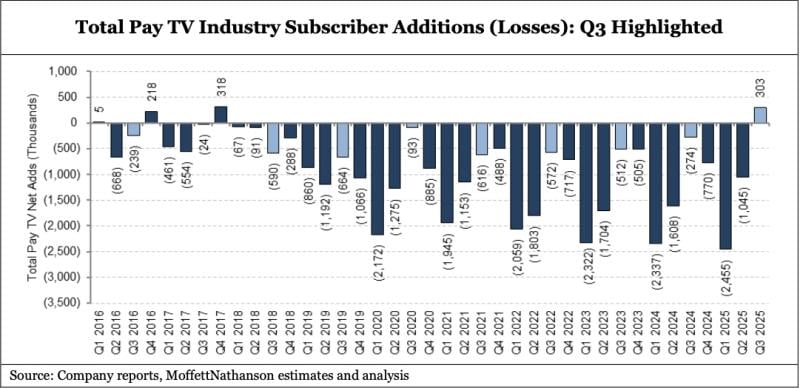
An anonymous reader quotes a report from Ars Technica: On Monday, research analyst MoffettNathanson released its "Cord-Cutting Monitor Q3 2025: Signs of Life?" report. It found that the pay TV operators, including cable companies, satellite companies, and virtual multichannel video programming distributors (vMVPDs) like YouTube TV and Fubo, added 303,000 net subscribers in Q3 2025. According to the report, "There are more linear video subscribers now than there were three months ago. That's the first time we've been able to say that since 2017."

In Q3 2017, MoffettNathanson reported that pay TV gained 318,000 net new subscribers. But since then, the industry's subscriber count has been declining, with 1,045,000 customers in Q2 2025, as depicted in the graph [here]. The world's largest vMVPD by subscriber count, YouTube TV, claimed 8 million subscribers in February 2024; some analysts estimate that number is now at 9.4 million. In its report, MoffettNathanson estimated that YouTube TV added 750,000 subscribers in Q3 2025, compared to 1 million in Q3 2024.

Traditional pay TV companies also contributed to the industry's unexpected growth by bundling its services with streaming subscriptions. Charter Communications offers bundles with nine streaming services, including Disney+, Hulu, and HBO Max. In Q3 2024, it saw net attrition of 294,000 customers, compared to about 70,000 in Q3 2025. Other cable companies have made similar moves. Comcast, for example, launched a streaming bundle with Netflix, Peacock, and Apple TV in May 2024. For Q3 2025, Comcast reported its best pay TV subscriber count in almost five years, which was a net loss of 257,000 customers.
"Traditional pay TV -- i.e. cable and satellite -- still declined quarter over quarter in Q3, but again, by less," noted SteamTV Insider. "The [year-over-year] rate of attrition dropped from -12.4 percent to -10.2 percent over 12 months."

MoffettNathanson added: "Yes, Q3 saw a positive net add number for [pay TV for] the first time in eight years, but that positive result came in the year's seasonally strongest quarter. We're not yet close to seeing the category actually grow again..."
Government

Rubio Orders Diplomats To Return To Using Times New Roman Font (reuters.com) 201

An anonymous reader quotes a report from Reuters: U.S. Secretary of State Marco Rubio on Tuesday ordered diplomats to return to using Times New Roman font in official communications, calling his predecessor Antony Blinken's decision to adopt Calibri a "wasteful" diversity move, according to an internal department cable seen by Reuters. The department under Blinken in early January 2023 had switched to Calibri, a modern sans-serif font, saying this was a more accessible font for people with disabilities because it did not have the decorative angular features and was the default in Microsoft products.

A cable dated December 9 sent to all U.S. diplomatic posts said that typography shapes the professionalism of an official document and Calibri is informal compared to serif typefaces. "To restore decorum and professionalism to the Department's written work products and abolish yet another wasteful DEIA program, the Department is returning to Times New Roman as its standard typeface," the cable said. "This formatting standard aligns with the President's One Voice for America's Foreign Relations directive, underscoring the Department's responsibility to present a unified, professional voice in all communications," it added.

Slashdot Top Deals