United States

US Army Soldier Pleads Guilty To AT&T and Verizon Hacks (techcrunch.com) 21

Cameron John Wagenius pleaded guilty to hacking AT&T and Verizon and stealing a massive trove of phone records from the companies, according to court records filed on Wednesday. From a report: Wagenius, who was a U.S. Army soldier, pleaded guilty to two counts of "unlawful transfer of confidential phone records information" on an online forum and via an online communications platform.

According to a document filed by Wagenius' lawyer, he faces a maximum fine of $250,000 and prison time of up to 10 years for each of the two counts. Wagenius was arrested and indicted last year. In January, U.S. prosecutors confirmed that the charges brought against Wagenius were linked to the indictment of Connor Moucka and John Binns, two alleged hackers whom the U.S. government accused of several data breaches against cloud computing services company Snowflake, which were among the worst hacks of 2024.

Cellphones

Free 'T-Mobile Starlink' for Six Months Announced During Super Bowl. Also Available to Verizon and AT&T Customers 211

Today T-Mobile announced what they're calling "the next big thing in wireless" — T-Mobile Starlink. But the real surprise is "The beta is now open for absolutely everyone — yes, even Verizon and AT&T customers — to register for free access until July."

And, as they explained to Americans watching the Super Bowl, "If you can see the sky you're connected." Now in public beta, this breakthrough service, developed in partnership with Starlink, uses straight-out-of-a-sci-fi-movie satellite and mobile communications technology to help keep people connected — even you, Verizon and AT&T customers — in the more than 500,000 square miles of the country unreached by any carrier's earth-bound cell towers. That's nearly the size of two Texases...! The beauty of the service is its simplicity: users don't need to do anything out of the ordinary. When a user's cell phone gets out of range of a cell tower, the phone automatically connects to the T-Mobile Starlink network. No need to manually connect. Messages are sent and received just as they are today on a traditional network, even group texts and reactions. And it works on most smartphones from the last four years. It's not limited to a few smartphones or operating systems...

The beta is free until July at which point T-Mobile Starlink will be included at no extra cost on Go5G Next (including variations like Go5G Next 55+), T-Mobile's best plan. Business customers will also get T-Mobile Starlink at no extra cost on Go5G Business Next, first responder agencies on T-Priority plans and other select premium rate plans. T-Mobile customers on any other plan can add the service for $15/month per line. Through February, T-Mobile customers who have registered for the beta can secure a $10/month per line Early Adopter Discount, 33% off the full price.

AT&T and Verizon customers hate dead zones, too

When your service is amazing and different, you want as many people to try it as possible. T-Mobile is giving AT&T and Verizon customers the opportunity to try out T-Mobile Starlink satellite service on their existing phones... During the beta period, Verizon and AT&T customers can experience T-Mobile Starlink text messaging for free, and once the service launches in July, it will be available for $20/month per line... More details and consumer registration can be found here.

A Vision for Universal Coverage

As T-Mobile and Starlink continue to work towards eliminating mobile deadzones, the companies welcome wireless providers from around the world to join their growing alliance, which aims to provide reciprocal roaming for all participating carriers. So far, KDDI (Japan), Telstra (Australia), Optus (Australia), One NZ (New Zealand), Salt (Switzerland), Entel (Chile & Peru), Rogers (Canada) and Kyivstar (Ukraine) are among the providers that have signed on to join the cause and launch satellite-to-mobile technology. Learn more about the alliance and how providers can join at direct.starlink.com.
China

DHS Terminates All Its Advisory Committees, Ending Its Investigation Into Chinese Telecom Hack (arstechnica.com) 144

An anonymous reader quotes a report from Ars Technica: The Department of Homeland Security has terminated all members of advisory committees, including one that has been investigating a major Chinese hack of large US telecom firms. "The Cyber Safety Review Board -- a Department of Homeland Security investigatory body stood up under a Biden-era cybersecurity executive order to probe major cybersecurity incidents -- has been cleared of non-government members as part of a DHS-wide push to cut costs under the Trump administration, according to three people familiar with the matter," NextGov/FCW reported yesterday.

A memo sent Monday by DHS Acting Secretary Benjamine Huffman said that in order to "eliminate[e] the misuse of resources and ensur[e] that DHS activities prioritize our national security, I am directing the termination of all current memberships on advisory committees within DHS, effective immediately. Future committee activities will be focused solely on advancing our critical mission to protect the homeland and support DHS's strategic priorities." The memo said advisory board members terminated this week "are welcome to reapply." The Cyber Safety Review Board's list of members included security experts from the private sector and lead cybersecurity officials from multiple government agencies.
"The CSRB was 'less than halfway' done with its Salt Typhoon investigation, according to a now-former member," wrote freelance cybersecurity reporter Eric Geller, who quoted an anonymous source as saying the Cyber Safety Review Board's review of Salt Typhoon is "dead." The former member was also quoted as saying, "There are still professional staff for the CSRB and I hope they will continue some of the work in the interim."

The Cyber Safety Review Board operates under (PDF) the DHS's Cybersecurity and Infrastructure Security Agency (CISA), notes Ars. The review board previously investigated a 2023 hack of Microsoft Exchange Online and more recently has been investigating how the Chinese hacking group called Salt Typhoon infiltrated major telecom providers such as Verizon and AT&T.
China

Are US Computer Networks A 'Key Battlefield' in any Future Conflict with China? (msn.com) 72

In a potential U.S.-China conflict, cyberattackers are military weapons. That's the thrust of a new article from the Wall Street Journal: The message from President Biden's national security adviser was startling. Chinese hackers had gained the ability to shut down dozens of U.S. ports, power grids and other infrastructure targets at will, Jake Sullivan told telecommunications and technology executives at a secret meeting at the White House in the fall of 2023, according to people familiar with it. The attack could threaten lives, and the government needed the companies' help to root out the intruders.

What no one at the briefing knew, including Sullivan: China's hackers were already working their way deep inside U.S. telecom networks, too. The two massive hacking operations have upended the West's understanding of what Beijing wants, while revealing the astonishing skill level and stealth of its keyboard warriors — once seen as the cyber equivalent of noisy, drunken burglars. China's hackers were once thought to be interested chiefly in business secrets and huge sets of private consumer data. But the latest hacks make clear they are now soldiers on the front lines of potential geopolitical conflict between the U.S. and China, in which cyberwarfare tools are expected to be powerful weapons. U.S. computer networks are a "key battlefield in any future conflict" with China, said Brandon Wales, a former top U.S. cybersecurity official at the Department of Homeland Security, who closely tracked China's hacking operations against American infrastructure. He said prepositioning and intelligence collection by the hackers "are designed to ensure they prevail by keeping the U.S. from projecting power, and inducing chaos at home."

As China increasingly threatens Taiwan, working toward what Western intelligence officials see as a target of being ready to invade by 2027, the U.S. could be pulled into the fray as the island's most important backer... Top U.S. officials in both parties have warned that China is the greatest danger to American security.

In the infrastructure attacks, which began at least as early as 2019 and are still taking place, hackers connected to China's military embedded themselves in arenas that spies usually ignored, including a water utility in Hawaii, a port in Houston and an oil-and-gas processing facility. Investigators, both at the Federal Bureau of Investigation and in the private sector, found the hackers lurked, sometimes for years, periodically testing access. At a regional airport, investigators found the hackers had secured access, and then returned every six months to make sure they could still get in. Hackers spent at least nine months in the network of a water-treatment system, moving into an adjacent server to study the operations of the plant. At a utility in Los Angeles, the hackers searched for material about how the utility would respond in the event of an emergency or crisis. The precise location and other details of the infrastructure victims are closely guarded secrets, and couldn't be fully determined.

American security officials said they believe the infrastructure intrusions — carried out by a group dubbed Volt Typhoon — are at least in part aimed at disrupting Pacific military supply lines and otherwise impeding America's ability to respond to a future conflict with China, including over a potential invasion of Taiwan... The focus on Guam and West Coast targets suggested to many senior national-security officials across several Biden administration agencies that the hackers were focused on Taiwan, and doing everything they could to slow a U.S. response in a potential Chinese invasion, buying Beijing precious days to complete a takeover even before U.S. support could arrive.

The telecom breachers "were also able to swipe from Verizon and AT&T a list of individuals the U.S. government was surveilling in recent months under court order, which included suspected Chinese agents. The intruders used known software flaws that had been publicly warned about but hadn't been patched."

And ultimately nine U.S. telecoms were breached, according to America's deputy national security adviser for cybersecurity — including what appears to have been a preventable breach at AT&T (according to "one personal familiar with the matter"): [T]hey took control of a high-level network management account that wasn't protected by multifactor authentication, a basic safeguard. That granted them access to more than 100,000 routers from which they could further their attack — a serious lapse that may have allowed the hackers to copy traffic back to China and delete their own digital tracks.
The details of the various breaches are stunning: Chinese hackers gained a foothold in the digital underpinnings of one of America's largest ports in just 31 seconds. At the Port of Houston, an intruder acting like an engineer from one of the port's software vendors entered a server designed to let employees reset their passwords from home. The hackers managed to download an encrypted set of passwords from all the port's staff before the port recognized the threat and cut off the password server from its network...
Crime

US Army Soldier Arrested In AT&T, Verizon Extortions (krebsonsecurity.com) 10

An anonymous reader quotes a report from KrebsOnSecurity: Federal authorities have arrested and indicted a 20-year-old U.S. Army soldier on suspicion of being Kiberphant0m, a cybercriminal who has been selling and leaking sensitive customer call records stolen earlier this year from AT&T and Verizon. As first reported by KrebsOnSecurity last month, the accused is a communications specialist who was recently stationed in South Korea. Cameron John Wagenius was arrested near the Army base in Fort Hood, Texas on Dec. 20, after being indicted on two criminal counts of unlawful transfer of confidential phone records. The sparse, two-page indictment (PDF) doesn't reference specific victims or hacking activity, nor does it include any personal details about the accused. But a conversation with Wagenius' mother -- Minnesota native Alicia Roen -- filled in the gaps.

Roen said that prior to her son's arrest he'd acknowledged being associated with Connor Riley Moucka, a.k.a. "Judische," a prolific cybercriminal from Canada who was arrested in late October for stealing data from and extorting dozens of companies that stored data at the cloud service Snowflake. In an interview with KrebsOnSecurity, Judische said he had no interest in selling the data he'd stolen from Snowflake customers and telecom providers, and that he preferred to outsource that to Kiberphant0m and others. Meanwhile, Kiberphant0m claimed in posts on Telegram that he was responsible for hacking into at least 15 telecommunications firms, including AT&T and Verizon. On November 26, KrebsOnSecurity published a story that followed a trail of clues left behind by Kiberphantom indicating he was a U.S. Army soldier stationed in South Korea.

[...] Immediately after news broke of Moucka's arrest, Kiberphant0m posted on the hacker community BreachForums what they claimed were the AT&T call logs for President-elect Donald J. Trump and for Vice President Kamala Harris. [...] On that same day, Kiberphant0m posted what they claimed was the "data schema" from the U.S. National Security Agency. On Nov. 5, Kiberphant0m offered call logs stolen from Verizon's push-to-talk (PTT) customers -- mainly U.S. government agencies and emergency first responders. On Nov. 9, Kiberphant0m posted a sales thread on BreachForums offering a "SIM-swapping" service targeting Verizon PTT customers. In a SIM-swap, fraudsters use credentials that are phished or stolen from mobile phone company employees to divert a target's phone calls and text messages to a device they control.

China

Dozens of Countries Hit in Chinese Telecom Hacking Campaign, Top US Official Says (msn.com) 41

China-linked spies may still be lurking in U.S. telecommunications networks — but the breach could be much, much wider. In fact, a "couple dozen" countries were hit by the attack, the Wall Street Journal reported this week, citing a top U.S. national security adviser. "Chinese government hackers have compromised telecommunications infrastructure across the globe as part of a massive espionage campaign..." Speaking during a press briefing Wednesday, Anne Neuberger, President Biden's deputy national security adviser for cyber and emerging technology, said the so-called Salt Typhoon campaign is ongoing and that at least eight telecommunications firms in the U.S. had been breached... The Journal previously identified Verizon, AT&T, T-Mobile and Lumen Technologies among the victims... [M]etadata grabs appeared to be "regional" in focus, and were likely a means to identify phone lines of valuable senior government officials, which the hackers then targeted to steal encrypted text messages and listen in on some phone calls, the official said... President-elect Donald Trump, Vice President-elect JD Vance, senior congressional staffers and an array of U.S. security officials were among scores of individuals to have their calls and texts directly targeted, an intelligence-collection coup that likely ensnared their private communications with thousands of Americans, the Journal has reported.

The senior administration official said the global tally of countries victimized was currently believed to be in the "low, couple dozen" but didn't give a precise figure. The global campaign of hacking activity dates back at least a year or two, the official said.

"Neuberger, on the press briefing, said that it wasn't believed that classified communications were accessed in the breaches."
Encryption

US Officials Urge Americans to Use Encrypted Apps Amid Unprecedented Cyberattack (nbcnews.com) 58

An anonymous reader shared this report from NBC News: Amid an unprecedented cyberattack on telecommunications companies such as AT&T and Verizon, U.S. officials have recommended that Americans use encrypted messaging apps to ensure their communications stay hidden from foreign hackers...

In the call Tuesday, two officials — a senior FBI official who asked not to be named and Jeff Greene, executive assistant director for cybersecurity at the Cybersecurity and Infrastructure Security Agency — both recommended using encrypted messaging apps to Americans who want to minimize the chances of China's intercepting their communications. "Our suggestion, what we have told folks internally, is not new here: Encryption is your friend, whether it's on text messaging or if you have the capacity to use encrypted voice communication. Even if the adversary is able to intercept the data, if it is encrypted, it will make it impossible," Greene said. The FBI official said, "People looking to further protect their mobile device communications would benefit from considering using a cellphone that automatically receives timely operating system updates, responsibly managed encryption and phishing resistant" multi-factor authentication for email, social media and collaboration tool accounts...

The FBI and other federal law enforcement agencies have a complicated relationship with encryption technology, historically advocating against full end-to-end encryption that does not allow law enforcement access to digital material even with warrants. But the FBI has also supported forms of encryption that do allow some law enforcement access in certain circumstances.

Officials said the breach seems to include some live calls of specfic targets and also call records (showing numbers called and when). "The hackers focused on records around the Washington, D.C., area, and the FBI does not plan to alert people whose phone metadata was accessed."

"The scope of the telecom compromise is so significant, Greene said, that it was 'impossible" for the agencies "to predict a time frame on when we'll have full eviction.'"
Security

Hacker In Snowflake Extortions May Be a US Soldier (krebsonsecurity.com) 20

An anonymous reader quotes a report from KrebsOnSecurity: Two men have been arrested for allegedly stealing data from and extorting dozens of companies that used the cloud data storage company Snowflake, but a third suspect -- a prolific hacker known as Kiberphant0m -- remains at large and continues to publicly extort victims. However, this person's identity may not remain a secret for long: A careful review of Kiberphant0m's daily chats across multiple cybercrime personas suggests they are a U.S. Army soldier who is or was recently stationed in South Korea.

Kiberphant0m's identities on cybercrime forums and on Telegram and Discord chat channels have been selling data stolen from customers of the cloud data storage company Snowflake. At the end of 2023, malicious hackers discovered that many companies had uploaded huge volumes of sensitive customer data to Snowflake accounts that were protected with nothing more than a username and password (no multi-factor authentication required). After scouring darknet markets for stolen Snowflake account credentials, the hackers began raiding the data storage repositories for some of the world's largest corporations. Among those was AT&T, which disclosed in July that cybercriminals had stolen personal information, phone and text message records for roughly 110 million people. Wired.com reported in July that AT&T paid a hacker $370,000 to delete stolen phone records.

On October 30, Canadian authorities arrested Alexander Moucka, a.k.a. Connor Riley Moucka of Kitchener, Ontario, on a provisional arrest warrant from the United States, which has since indicted him on 20 criminal counts connected to the Snowflake breaches. Another suspect in the Snowflake hacks, John Erin Binns, is an American who is currently incarcerated in Turkey. Investigators say Moucka, who went by the handles Judische and Waifu, had tasked Kiberphant0m with selling data stolen from Snowflake customers who refused to pay a ransom to have their information deleted. Immediately after news broke of Moucka's arrest, Kiberphant0m was clearly furious, and posted on the hacker community BreachForums what they claimed were the AT&T call logs for President-elect Donald J. Trump and for Vice President Kamala Harris. [...] Also on Nov. 5, Kiberphant0m offered call logs stolen from Verizon's push-to-talk (PTT) customers -- mainly U.S. government agencies and emergency first responders.
Kiberphant0m denies being in the U.S. Army and said all these clues were "a lengthy ruse designed to create a fictitious persona," reports Krebs.

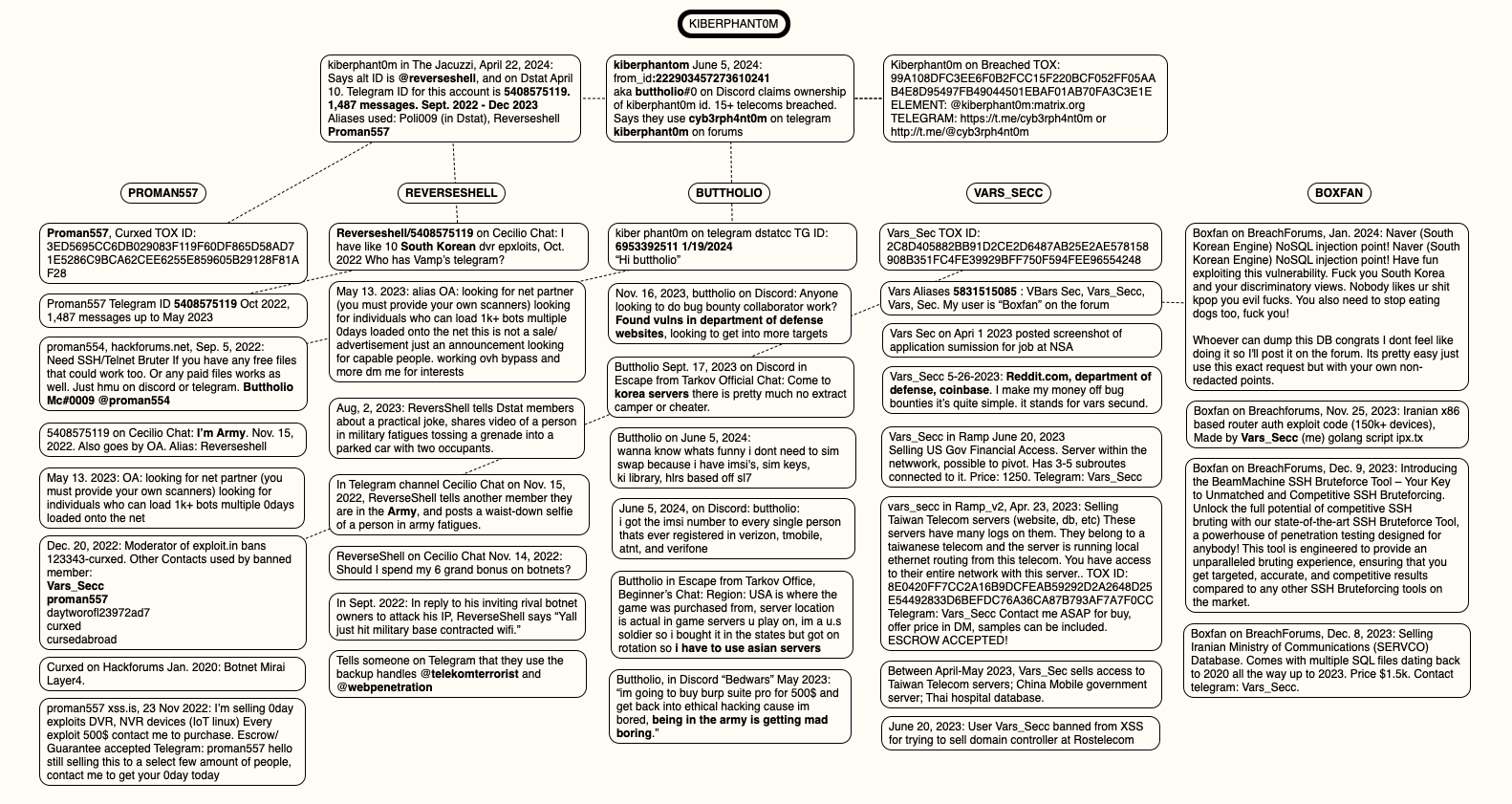
"I literally can't get caught," Kiberphant0m said, declining an invitation to explain why. "I don't even live in the USA Mr. Krebs." A mind map illustrates some of the connections between and among Kiberphant0m's apparent alter egos.
The Internet

ISPs Say Their 'Excellent Customer Service' Is Why Users Don't Switch Providers (arstechnica.com) 76

Ars Technica's Jon Brodkin reports: Lobby groups for Internet service providers claim that ISPs' customer service is so good already that the government shouldn't consider any new regulations to mandate improvements. They also claim ISPs face so much competition that market forces require providers to treat their customers well or lose them to competitors. Cable lobby group NCTA-The Internet & Television Association told the Federal Communications Commission in a filing (PDF) that "providing high-quality products and services and a positive customer experience is a competitive necessity in today's robust communications marketplace. To attract and retain customers, NCTA's cable operator members continuously strive to ensure that the customer support they provide is effective and user-friendly. Given these strong marketplace imperatives, new regulations that would micromanage providers' customer service operations are unnecessary."

Lobby groups filed comments in response to an FCC review of customer service that was announced last month, before the presidential election. While the FCC's current Democratic leadership is interested in regulating customer service practices, the Republicans who will soon take over opposed the inquiry. USTelecom, which represents telcos such as AT&T and Verizon, said that "the competitive broadband marketplace leaves providers of broadband and other communications services no choice but to provide their customers with not only high-quality broadband, but also high-quality customer service."

"If a provider fails to efficiently resolve an issue, they risk losing not only that customer -- and not just for the one service, but potentially for all of the bundled services offered to that customer -- but also any prospective customers that come across a negative review online. Because of this, broadband providers know that their success is dependent upon providing and maintaining excellent customer service," USTelecom wrote. While the FCC Notice of Inquiry said that providers should "offer live customer service representative support by phone within a reasonable timeframe," USTelecom's filing touted the customer service abilities of AI chatbots. "AI chat agents will only get better at addressing customers' needs more quickly over time -- and if providers fail to provide the customer service and engagement options that their customers expect and fail to resolve their customers' concerns, they may soon find that the consumer is no longer a customer, having switched to another competitive offering," the lobby group said.

AT&T

US Cellular To Sell Some Spectrum Licenses To AT&T For $1 Billion (reuters.com) 2

U.S. Cellular has agreed to sell $1.02 billion worth of spectrum licenses to AT&T as part of its strategy to monetize its spectrum assets that were not included in an earlier $4.4 billion deal with T-Mobile. Reuters reports: Last month, U.S. Cellular agreed to sell select spectrum licenses for $1 billion to Verizon. It also signed deals with two other mobile network operators, but did not disclose the details. The latest agreement "adds a fourth mobile network operator, in addition to T-Mobile, to the list of those whose subscribers will benefit from the sale of our spectrum licenses," U.S. Cellular CEO Laurent Therivel said on Thursday. From a press release: Following this transaction, as well as those previously announced, UScellular will have reached definitive agreements to monetize approximately 55%, measured on a MHz-Pops basis, of the spectrum holdings (excluding mmWave) that were excluded from the proposed sale to T-Mobile, for a total consideration of approximately $2.02 billion. Including the proposed T-Mobile transaction, UScellular will have reached agreements to monetize approximately 70% of its total spectrum holdings (excluding mmWave), measured on a MHz-Pops basis.

"After our proposed sales, we will be left with 1.86 billion MHz-Pops of low and mid-band spectrum, as well as 17.2 billion MHz-Pops of mmWave spectrum, with the substantial majority of retained value in the C-band spectrum," [said Laurent C. Therivel, President and CEO]. "The C-band licenses have a number of attributes that we believe are favorable to their long-term value. First, our C-band licenses are positioned in an attractive mid-band frequency that can deliver outstanding speed and capacity. Second, there is a substantial 5G ecosystem of equipment vendors and existing infrastructure that uses C-band. Finally, they have a lengthy build-out timeline, with first and second build-out dates of 2029 and 2033, respectively. This provides ample time and optionality for us to either monetize or deploy the spectrum in the future. We will continue to look for ways to opportunistically monetize the C-band, as well as the other remaining spectrum."

AT&T

AT&T Announces $1 Billion Fiber Deal With Corning (reuters.com) 10

AT&T has signed a $1 billion multi-year deal with Corning to acquire fiber and connectivity solutions. Reuters reports: With the U.S. wireless market facing a slowdown, telecom companies such as AT&T and rival Verizon have doubled down on their high-speed internet businesses, an area that has long been dominated by broadband companies such as Comcast. Demand has also been growing for AT&T's plans that allow customers to combine its high-speed fiber data with its wireless phone service for a discount. In the third quarter, AT&T reported 28.3 million fiber passings, or the number of potential customer locations a fiber network passes by. It remains on track to pass more than 30 million fiber passings by the end of 2025.
The Internet

One Argument Why Data Caps Are Not a Problem (fierce-network.com) 181

NoWayNoShapeNoForm writes: OpenVault believes that data caps on broadband are not a problem because most people do not exceed their existing data caps. OpenVault contends that people that do exceed their broadband data caps are simply being forgetful — leaving a streaming device on 24x7, or deploying unsecure WiFi access points, or reselling their service within an apartment building.

Yes, there may be some ISPs that have older networks that they have not upgraded. Or maybe they are unable to increase network capacity in "the middle mile" of their networks, but the Covid pandemic certainly encouraged many ISPs to upgrade their networks and capacity while many ISPs that had broadband data caps ended that feature.

Perhaps the biggest problem, according to OpenVault, is that most broadband users do not really have any idea how much bandwidth they "consume" every month. If Internet access is a service that people want to treat as a "utility", then you have to ask, Would they keep the water running after finishing their shower?

In the article Ookla's VP of Smart Communities adds that "Scrolling through social media feeds for hours can 'push' hundreds of videos to the user, many of which may be of no interest — they just start running." So the main driver for usage-based billing wasn't to increase revenue, OpenVault CEO Mark Trudeau tells the site, but to "balance the network a little more..." (Though he then also adds that sometimes a subscriber could also be reselling broadband service in their apartment building, "And that's not even legal.")

"If one or two customers on a given node is causing issues for 300 others, where those 300 are not getting the service that they paid for, then that's a problem right?" he said.

Having said that, the article also points out that "Many major fiber providers, like AT&T, Frontier, Google Fiber and Verizon Fios, don't have data caps at all."
China

US Officials Race To Understand Severity of China's Salt Typhoon Hacks (msn.com) 20

U.S. officials are racing to understand the full scope of a China-linked hack of major U.S. broadband providers, as concerns mount from members of Congress that the breach could amount to a devastating counterintelligence failure. From a report: Federal authorities and cybersecurity investigators are probing the breaches of Verizon Communications, AT&T and Lumen Technologies. A stealthy hacking group known as Salt Typhoon tied to Chinese intelligence is believed to be responsible. The compromises may have allowed hackers to access information from systems the federal government uses for court-authorized network wiretapping requests, The Wall Street Journal reported last week.

Among the concerns are that the hackers may have essentially been able to spy on the U.S. government's efforts to surveil Chinese threats, including the FBI's investigations. The House Select Committee on China sent letters Thursday asking the three companies to describe when they became aware of the breaches and what measures they are taking to protect their wiretap systems from attack. Spokespeople for AT&T, Lumen and Verizon declined to comment on the attack. A spokesman at the Chinese Embassy in Washington has denied that Beijing is responsible for the alleged breaches.

Combined with other Chinese cyber threats, news of the Salt Typhoon assault makes clear that "we face a cyber-adversary the likes of which we have never confronted before," Rep. John Moolenaar, the Republican chairman of the House Select Committee Committee on China, and Raja Krishnamoorthi, the panel's top Democrat, said in the letters. "The implications of any breach of this nature would be difficult to overstate," they said. Hackers still had access to some parts of U.S. broadband networks within the last week, and more companies were being notified that their networks had been breached, people familiar with the matter said. Investigators remain in the dark about precisely what the hackers were seeking to do, according to people familiar with the response.

China

U.S. Wiretap Systems Targeted in China-Linked Hack (msn.com) 27

"A cyberattack tied to the Chinese government penetrated the networks of a swath of U.S. broadband providers," reports the Wall Street Journal, "potentially accessing information from systems the federal government uses for court-authorized network wiretapping requests.

"For months or longer, the hackers might have held access to network infrastructure used to cooperate with lawful U.S. requests for communications data, according to people familiar with the matter, which amounts to a major national security risk." The attackers also had access to other tranches of more generic internet traffic, they said. Verizon Communications, AT&T and Lumen Technologies are among the companies whose networks were breached by the recently discovered intrusion, the people said.

The widespread compromise is considered a potentially catastrophic security breach and was carried out by a sophisticated Chinese hacking group dubbed Salt Typhoon. It appeared to be geared toward intelligence collection, the people said... The surveillance systems believed to be at issue are used to cooperate with requests for domestic information related to criminal and national security investigations. Under federal law, telecommunications and broadband companies must allow authorities to intercept electronic information pursuant to a court order. It couldn't be determined if systems that support foreign intelligence surveillance were also vulnerable in the breach...

The hackers appear to have engaged in a vast collection of internet traffic from internet service providers that count businesses large and small, and millions of Americans, as their customers. Additionally, there are indications that the hacking campaign targeted a small number of service providers outside the U.S., the people said. A person familiar with the attack said the U.S. government considered the intrusions to be historically significant and worrisome... "It will take time to unravel how bad this is, but in the meantime it's the most significant in a long string of wake-up calls that show how the PRC has stepped up their cyber game," said Brandon Wales, former executive director at the Cybersecurity and Infrastructure Security Agency and now a vice president at SentinelOne, referring to the People's Republic of China. "If companies and governments weren't taking this seriously before, they absolutely need to now."

Three weeks ago TechCrunch also reported that the FBI "took control of a botnet made up of hundreds of thousands of internet-connected devices, such as cameras, video recorders, storage devices, and routers, which was run by a Chinese government hacking group, FBI director Christopher Wray and U.S. government agencies revealed Wednesday.
Businesses

Verizon Leases Over 6,300 Wireless Towers To Vertical Bridge For $3.3 Billion (capacitymedia.com) 26

Vertical Bridge has acquired the rights to lease and operate over 6,000 wireless towers from Verizon for $3.3 billion as part of a 10-year agreement, with potential extensions of up to 50 years. Capacity Media reports: "Upon the completion of this transaction, these assets, together with our existing portfolio which includes thousands of young, purpose-built towers, enhance Vertical Bridge's position as a fast, friendly, and flexible colocation partner to the wireless industry," said Ron Bizick, President and CEO of Vertical Bridge. Terms of the deal provide Verizon access to additional space on the towers for future use.

The US carrier said its latest deal with Vertical Bridge supports existing efforts to drive tower-related costs. "As the nation's largest mobility provider, we are well positioned with greater financial flexibility to invest in our business, return value to our shareholders and make the nation's best network even better for customers," said Hans Vestberg, chair and CEO of Verizon. The transaction is expected to close by the end of 2024, subject to closing conditions.
Earlier this month, Verizon announced a deal to acquire Frontier Communications for $9.6 billion.
Verizon

Verizon Cellphone Users Report Outages Across the US 60

Thousands of Verizon users across the United States reported having little or no cellphone service on Monday morning in major cities, including in Atlanta, Chicago, Denver, New York and Phoenix. From a report: According to the website Downdetector, which tracks user reports of internet disruptions, more than 104,000 cases of Verizon outages were reported across the country as of 11:20 a.m. Eastern, more than an hour after the first issues were reported.

A map posted on the site showed cities with the most reports. On the site, many users said their cellphones were intermittently displaying SOS mode and that they could not place calls or send or receive text messages. "We're aware of the issue affecting service for some customers," a spokesman for Verizon, Ilya Hemlin, said in a telephone interview at 11:30 a.m. "Our engineers are engaged and we are working quickly to solve the issue," he added.
Cellphones

Are Your Phone's 5G Icon and Signal Bars Lying to You? (msn.com) 47

An anonymous reader shared this report from the Washington Post: Look at the top right corner of your phone. You might see an icon with "5G" and another with vertical bars showing the strength of your internet connection. Those symbols don't mean what you think they do.

If your phone shows "5G," you're not necessarily connected to the latest and zippiest cellphone network technology. It might just mean that 5G connections are available nearby. And the bars are a cellular version of a shrug. There is no standard measure of how much signal strength each bar represents. "The connection icon is a lie," said Avi Greengart, president of the technology analysis firm Techsponential...

The good news is you might not need 5G, anyway. Most of the time, your phone calls, texting and web surfing are perfectly fine on the prior generation of wireless technology called 4G or sometimes "LTE." Many phone networks will funnel you over 5G service when it makes a real difference, like if you're on a video call or playing an intense video game.

If you see more specific types of 5G icons, like "5G UW" used by Verizon or "5G UC" if you're on T-Mobile service, Hyers said you're probably connected to a 5G network at that moment. Those extra letters or symbols sometimes indicate types of 5G technology that are capable of faster and more reliable connections, but they aren't always better, depending on your circumstances. Confusingly, AT&T has showed "5G E" icons on phones. That is not 5G service at all.

Here's how major carriers responded to the Post's reporter:
  • "AT&T said its '5G' indicators on phones line up with a telecommunications standards organization that established the icon to mean 5G networks are available."
  • "Verizon didn't respond to my questions."
  • "T-Mobile said for most of its cellphone network, your phone accurately reflects if you're on 5G."

The article suggests setting your phone to just automatically switch to 5G networks when high-bandwidth applications are in use...


The Internet

ISPs Tell Supreme Court They Don't Want To Disconnect Users Accused of Piracy (arstechnica.com) 72

Joe_Dragon shares a report: Four more large Internet service providers told the US Supreme Court this week that ISPs shouldn't be forced to aggressively police copyright infringement on broadband networks. While the ISPs worry about financial liability from lawsuits filed by major record labels and other copyright holders, they also argue that mass terminations of Internet users accused of piracy "would harm innocent people by depriving households, schools, hospitals, and businesses of Internet access."

The legal question presented by the case "is exceptionally important to the future of the Internet," they wrote in a brief filed with the Supreme Court on Monday. The amici curiae brief was filed by Altice USA (operator of the Optimum brand), Frontier Communications, Lumen (aka CenturyLink), and Verizon. The brief supports cable firm Cox Communications' attempt to overturn its loss in a copyright infringement lawsuit brought by Sony. Cox petitioned the Supreme Court to take up the case last month.

Sony and other music copyright holders sued Cox in 2018, claiming it didn't adequately fight piracy on its network and failed to terminate repeat infringers. A US District Court jury in the Eastern District of Virginia ruled in December 2019 that Cox must pay $1 billion in damages to the major record labels. Cox won a partial victory when the US Court of Appeals for the 4th Circuit vacated the $1 billion verdict, finding that Cox wasn't guilty of vicarious infringement because it did not profit directly from infringement committed by users of its cable broadband network. But the appeals court affirmed the jury's finding of willful contributory infringement and ordered a new damages trial.

Software

Linus Torvalds Muses About Maintainer Gray Hairs, Next 'King of Linux' (zdnet.com) 45

An anonymous reader quotes a report from ZDNet, written by Steven Vaughan-Nichols: In a candid keynote chat at the Linux Foundation's Open Source Summit Europe, Linux creator Linus Torvalds shared his thoughts on kernel development, the integration of Rust, and the future of open source. Dirk Hohndel, Verizon's Open Source Program Office head and Torvalds friend, moderated their conversation about the Linux ecosystem. Torvalds emphasized that kernel releases, like the recent 6.11 version, are intentionally not exciting. "For almost 15 years, we've had a very good regular cadence of releases," he explained. With releases every nine weeks, this regularity aims for timeliness and reliability rather than flashy new features. The Linux creator noted that while drivers still make up the bulk of changes, core kernel development continues to evolve. "I'm still surprised that we're doing very core development," Torvalds said, mentioning ongoing work in virtual file systems and memory management. [...]

Shifting back to another contentious subject -- maintainer burnout and succession planning -- Hohndel observed that "maintainers are aging. Strangely, some of us have, you know, not quite as much or the right hair color anymore." (Torvalds interjected that "gray is the right color.") Hohndel continued, "So the question that I always ask myself: Is it about time to talk about there being a mini-Linus?" Torvalds turned the question around. True, the Linux maintainers are getting older and people do burn out and go away. "But that's kind of normal. What is not normal is that people actually stay around for decades. That's the unusual thing, and I think that's a good sign." At the same time, Torvalds admitted, it can be intimidating for a younger developer to join the Linux kernel team "when you see all these people who have been around for decades, but at the same time, we have many new developers. Some of those new developers come in, and three years later, they are top maintainers."

Hohndel noted that "to be the king of Linux, the main maintainer, you have to have a lot of experience. And the backup right now is Greg KH (Greg Kroah-Hartman, maintainer of the stable Linux kernel), who is about the same age as we are and has even less hair." True, Torvalds responded, "But the thing is, Greg hasn't always been Greg. Before Greg, there's been Andrew {Morton) and Alan (Cox). After Greg, there will be Shannon and Steve. The real issue is you have to have a person or a group of people that the development community can trust, and part of trust is fundamentally about having been around for long enough that people know how you work, but long enough does not mean to be 30 years." Hohndel made one last comment: "What I'm trying to say is, you've been doing this for 33 years. I don't want to be morbid, but I think in 33 years, you may no longer be doing this?" Torvalds, making motions as though he was using a walker, replied, "I would love to still do this conference with you."
The report notes the contention around the integration of Rust, highlighted by the recent departure of Rust for Linux maintainer Wedson Filho. Despite resistance from some devs who prefer C and are skeptical of Rust, Torvalds remains optimistic about Rust's future in the kernel.

He said: "Rust is a very different thing, and there are a lot of people who are used to the C model. They don't like the differences, but that's OK. In the kernel itself, absolutely nobody understands everything. I don't. I rely heavily on maintainers of various subsystems. I think the same can be true of Rust and C. I think it's one of our strengths in the kernel that we can specialize. Clearly, some people just don't like the notion of Rust and having Rust encroach on their area. But we've only been doing Rust for a couple of years, so it's way too early to say Rust is a failure."

Meanwhile, Torvalds confirmed that the long-anticipated real-time Linux (RTLinux) project will finally be integrated into the kernel with the upcoming release of Linux 6.12.
Cellphones

Americans Used Record 100 Trillion Megabytes of Wireless Data In 2023 (reuters.com) 81

A new survey released on Tuesday found that Americans used over 100 trillion megabytes of wireless data last year -- a 36% increase from the previous year and the largest single-year increase in the history of wireless data consumption. Reuters reports: The increase -- 26 trillion MBs over 2022 -- comes as a growing number of 5G wireless devices are being used, said wireless industry association CTIA that represents major wireless carriers like Verizon, AT&T, T-Mobile, and technology firms. The total number of wireless connections rose to 558 million last year, up 6% over 2022, the survey found.

Demand for spectrum use is soaring, driven in part by more wireless use in advancements including drones, self-driving vehicles, space missions and precision agriculture. The survey said the number of minutes Americans spent talking on the phone fell slightly from 2.5 trillion in 2022 to 2.4 trillion in 2023 and text messages were about the same at 2.1 trillion in 2023 over the prior year.

Slashdot Top Deals