


Amazon Sneaks One-Click Past the Patent System 104
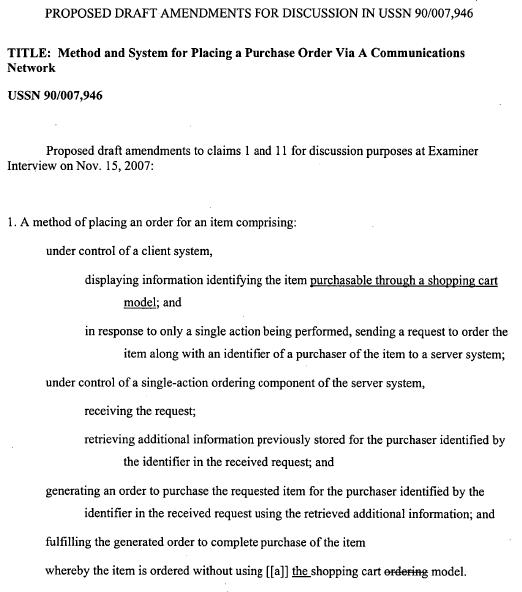
theodp writes "By changing the word 'a' to 'the' and adding the phrase 'purchasable through a shopping cart model,' lawyers for Amazon.com have apparently managed to reinstate two of CEO Jeff Bezos' 1-Click Patent claims that were rejected a month earlier. 'Patent Owner's Rep was informed that the proposed addition to the claims appear to place the claims in condition of patentability,' writes the USPTO in its Ex Parte Reexamination Interview Summary of the 11-15 conference call that was held with five representatives of the USPTO and patent reformer Amazon."


Ack! (Score:2, Informative)
Re: (Score:3, Informative)
Re:Ack! (Score:5, Interesting)
would that be a normal web developer or a normal database admin? because, the db admin will not be surprised regardless of the amount of data you throw at a button.
anyways, we can use one click checkouts as long as they have nothing to do with the shopping cart model right?
gentlemen I'd like to introduce the shopping 'list' model, which differs from the shopping cart model in that all items *must* be 'listed' on the page the shopper is browsing, allowing them the immediate convenience of seeing their purchases at any given time, furthermore I'd also like to patent the one click to "hand your butler the shopping list" purchasing model, where the butler is an AI avatar that essentially completes your shopping, the actual process of filling your shopping cart and checking out, for you. fuck you amazon! now we have a butler, do you have a BUTLER?!? hmm, this actually wouldn't be bad if the butler was capable of shopping at more than one site, and finding good prices on stuff, just for good measure I'll copyright this post.
all references to 'shopping list', 'one click butler avatar', and the term "fuck you amazon! now we have a butler, do you have a BUTLER?!?" are copyrighted by cyphercell (843398) © and will be defended to the full extent of the law if my lawyer thinks it's worth it
Re: (Score:3, Insightful)
This had nothing to do with changing a few words in the patent and everything to do with money being spread around in the right places.
I'm telling you, we are the ones being consumed.
Re: (Score:2, Informative)
DMCA TAKEDOWN BIATCH!!! easier than I thought! (Score:4, Funny)
DIGITAL MILLENNIUM COPYRIGHT ACT
1. Detailed identity of the copyrighted work that I believe has been infringed upon. This includes identification of the web page or specific posts, as opposed to entire sites. Posts must be referenced by either the dates in which they appear or the permalink of the post
http://slashdot.org/comments.pl?sid=368407&cid=21450629 [slashdot.org]
2. Identity of the material that I claim is infringing upon the copyrighted work listed in item #1 above.
'shopping list model'
3. Location of the author copyright notice (for information).
http://slashdot.org/comments.pl?sid=368407&cid=21448235 [slashdot.org]
4. Information to permit our company, the provider, to contact you.
http://slashdot.org/~cyphercell/journal/188515 [slashdot.org]
5. Statements
http://en.wikipedia.org/wiki/DMCA#Example_of_DMCA_Takedown_Provision [wikipedia.org]Reproduce the next statements:
I have a good faith belief that use of the copyrighted materials (didn't you see the © - that's real shit man) described above on the infringing web pages is not authorized by my registered copyright and by the law (gimme money, money, money, bwahhahah). I swear, under penalty of perjury, that the information in the notification is accurate and that I am the copyright owner of an exclusive right that is infringed.
cyphercell (843398)
I hate to ask (Score:2, Interesting)
Re: (Score:2, Insightful)
Re: (Score:3, Insightful)
Prior art? (Score:3, Interesting)
Re:Prior art? (Score:4, Informative)
No, that's not right. (Score:5, Funny)
Let's see:
There. Fixed that for ya.
Something's missing (Score:3, Funny)
Re: (Score:2, Informative)
In claim drafting, you must first introduce a word or concept with "a" or "an" and then you refer back to it with "the" or "said." If you do not the claim will not be allowed.
The change from "a" to "the" did not magically change the claim from being invalid to allowable.
The wheel (Score:3, Funny)
Re: (Score:3, Funny)
Re:The wheel (Score:4, Informative)
More at CNN [cnn.com].
Re: (Score:2)
That should be:
I better hurry patenting a wheel before it's too late... the one purchasable through a shopping cart model that is.
Re: (Score:2)
Re: (Score:1)
Now I need a patent for posting a sarcastic remark through the Slashdot comment model and sue you guys for royalties.
Re: (Score:2)
Re: (Score:1)
Re: (Score:2)
Re: (Score:3, Funny)
there was more to it... (Score:5, Funny)
Re: (Score:1)
:facepalms: (Score:5, Funny)
Re: (Score:3, Insightful)
Re: (Score:2)
Re: (Score:1)
You forgot the biggest step... (Score:2)
Abuse of the system (Score:2)
Re:Abuse of the system (Score:4, Informative)
Where is the abuse of the system here? Amazon is playing by all the rules set forth by Congress [cornell.edu] and the Patent Office [uspto.gov]. If prior art is found that reads on their claim, they amend the claim by adding more limitations (making it more specific) so that the claim overcomes the art rejection. The new limitations generally come from the dependent claims and must have adequate written description in the original patent application.
The /. posting is very misleading. First, the claim was amended with a further limitation "purchasable through a shopping cart model," to an already lengthy claim. The change of "a" to a "the" cleans up the antecedent basis problem (i.e., which shopping cart model is the last line referring to, the same one of line 3, or a different one). Second, this claim is still not in condition for allowance! The patent examiner looked at the new limitation and agreed that it probably overcomes the art currently rejecting the claim. He still gets to closely re-read the art of reference and conduct additional search before he can determine whether the claim is allowable.
And finally, I want everyone to look at the claim, not the title of the patent, and then, without impermissible hindsight, get to work finding prior art to read on the claim. Just saying that a single click of the mouse is obvious makes you look dumb. That's your homework for this week, now get to work!
Non-trivial step above prior art? (Score:2)
What 1-click is and why it shouldn't be patentable (Score:5, Informative)
The problem is, the whole reason cookies were created was precisely to enable on-line shopping:
http://www.ietf.org/rfc/rfc2109.txt [ietf.org]
So soon after the RFC was *announced* Amazon requested a patent for doing what the RFC was specifically designed for. If you ignore the sleeziness of the action, it would be virtually impossible to find prior art since no implementation was possible before the standard was approved. And even if an early implementations of cookies existed, since Amazon was one of the few e-commerce site out there at the time, there would be virtually no chance of finding another prior art implementation.
Now you could go to the real-world analogy of going to a friendly store and pointing at a bunch of things and saying "Charge it", but since it's done by "a computer" it magically turns into a completely different thing.
Re: (Score:2)
Re: (Score:2)
Re: (Score:2)
Re: (Score:2)
Why?
Broken System (Score:4, Insightful)
Re: (Score:1, Insightful)
Re: (Score:1)
BUT!
In a way, it does promote innovation. The companies that find themselves halted by the existence of a particular patent are forced to one of the following
a) either they innovate in such a way that they get around the problem by creating some new service/product/technique to achieve the same, similar or an acceptable substitute result or
b) they innovate in the language and law research by using legal rabbit holes to circumvent
Re: (Score:2)
Patents are not inherently bad. Bad patents are.
Re: (Score:2, Insightful)
Re: (Score:1)
Hold on a minute ! (Score:1)
__
A Lost Frenchman
Re: (Score:2)
We shoulda thought of that sooner...
It depends on what the words 'is' means (Score:3, Funny)
Thank you very much!
Boycott Amazon (Score:2)
Who dares to put his money where his mouth is?
Ah hah... I supposed.
Re: (Score:2)
(My money isn't where my mouth is, though: it's in my pocket; my mouth is on my face.)
Slugs do as slugs does. Calling RMS! (Score:1)
Hmmm I knew that those sneaky sons of a
Has RMS weighed in on this yet?
AMAZON Sucks for two reasons: ( 2++ reasons actually )
1. The whole "We're patenting prior art" on "One click shopping"(tm),
2. It hurts the local book stores. ( I *LOVE* my local book stores. )
and
3. Amazon does not get me out of the house to meet cute chicks at said local book stores.
( no one on the internet knows: A) Your a Dog, and WORSE B) you shop at Amazon )
I canceled my account there years ago, af
Re: (Score:2)
Will Slashdot Ever Get It? (Score:2, Insightful)
Here on Slashdot, it looks like everybody enjoys conflating the issues of 1) whether we should have software patents at all and 2) whether the subject matter of this patent is obvious or not. It may be way too late for any meaningful discussion of this patent here on Slashdot, but keeping those two things separate would help out there.
So I'd like to make an argument here, and see if I actually get any constructive respons
I dunno, will you? (Score:3, Insightful)
You can't determine how broad a patent is by counting how many elements a claim has. Most of the elements of the claims of the Amazon patent don't limit the claims. Despite your verbal acrobatics and distortions, the patent is broad.
(And those are not "claims" those are "elem
Re:Will Slashdot Ever Get It? (Score:4, Insightful)
Re:Will Slashdot Ever Get It? (Score:5, Insightful)
Let's break that down with some specifics:
1. A method of placing an order for an item comprising;
1) a web browser
2) a web page about an item
3) where pushing "buy now" causes the web browser to send a "buy this item now" message to a web server
4) a web server
5) receives te request
6) looks up the purchaser's credit card number
7) creates an order for that purchaser in the order processing system which
8) Processes the order
9) all without a shopping cart
I suggest that the only potentially novel thing here is #3. And, I suggest that #3 is obvious -- the only reason that nobody was doing it before hand was that nobody had previously considered the problem of reducing the number of clicks it takes to get somebody to buy something.
Re: (Score:1)
Re: (Score:1)
Re: (Score:1)
I might be wrong, but I don't see that many elements that an e-commerce site could leave out and still be fully functional. Actually, #1 to #8 are pretty much essential and #3 in particular is extremely broad and potentially troublesome:
Your run-of-the-mill
Re: (Score:2)
Where is the slight of hand here? Amazon's patent lawyers are trying to add additional limitations to overcome the art rejection set forth by the patent examiner. That's how patents work (not simply software patents). The inventor comes up with a new widget, broadly defines the widget in a series of claims, and thr
Re:Will Slashdot Ever Get It? (Score:4, Insightful)
One-click was always trivially obvious to anyone and everyone who'd had anything to do with anything even remotely like thinking about the problem.
Received wisdom was that one-click was a bad idea, because (a) people would misclick and buy something they didn't want, and (b) people would be scared off from the site they were scared of misclicking. But this was received wisdom; everybody before Amazon thought one-click was a bad idea--but that means everyone knew about one click already.
Maybe Amazon gets points for figuring out how to make it work pyschologically for people (if they even have--I have one-click disabled), but that's not the part that's being patented, and is surely not the part that people are talking about being obvious. Of course the ideal of clicking once was obvious--that's how the vast majority of actions on the computer worked, e.g. following hyperlinks! Or submitting a form! How could the action 'buy' not be obvious as one click as well? How could you possibly think that? And the implementation is trivial (the site just needs to know who you are, which it does if you're you logged in, whether with cookies or just earlier in the session and you have a session ID in the url).
There's a GUI rule of thumb that everything should be undoable, and anything you can't make undoable should have a confirmation dialog? That's the exact same principle that underlies both the common wisdom against 1-click (require confirmation) and Amazon's specific solution (allow undoing the order).
If you think this wasn't obvious, you can choke on a turkey.
Re:Will Slashdot Ever Get It? (Score:4, Insightful)
Received wisdom was that one-click was a bad idea
That's really the key of it. It was obvious to everybody: obvious that it was such a bad idea that nobody should do it.
Except that it turned out that it was a really good idea, if you offset the "flaw" (no confirmation) with undoability. Good enough that other sites started doing it, too, and had to stop because of the patent.
I'm trying to think of other things that were "obviously bad ideas" which are now good ideas because of offsetting techology. Verbose, self-descriptive, text-based, network-transmitted file formats? Garbage collection? Hell, digital audio was obvious, but also obviously dumb due to the poor quality and large file sizes. But if you patented some of these in 1970, would they be valid?
Re: (Score:2)
And an old idea it is. People used to walk into shops is their towns. They greeted the owner (they knew eachother). They said "John, order me the thingy and deliver it to my home, please", said goodbye and left.
And this is supposed to be patentable now just because it runs on computers connected through a network?
Re: (Score:2)
Re: (Score:2)
Re: (Score:2)
I *know* that all these concepts are ancient. That was precisely why I mentioned them.
People are saying that "one-click was obvious; the only reason there's no prior art was because we thought it was a bad idea at the time." In retrospect, it was only a bad idea if you couldn't undo it.
So let's take digital audio, which was "obvious" by the early 20th century - yet not really usable until we developed good converters. And once you h
Re: (Score:2)
Re: (Score:2)
Whoah there, Freedom Boy. Perhaps when you were out buying straw, you missed the part where I've repeatedly said I think that this patent is a bad thing?
I just said I think that, under the current (U.S.) laws, it may be valid. And even those laws don't go as far as your Ray Bolger impression. The first one to apply for a patent gets it unless some
Re: (Score:1)
Re: (Score:1)
The commercial success idea is that if an idea met with commercial success, and that commercial success was substantially connected to the claimed invention, then t
Re:Will Slashdot Ever Get It? (Score:5, Insightful)
Vending machines are one click shopping models. Put your money in, then click the button for the item you want. Amazon includes the "putting your money in" step when you sign up for an account; there's no reason you couldn't put $1,000 in a vending machine and come back whenever you wanted something and get a "one click" shopping experience. Patenting an existing business model just by doing it on the Internet is silly, otherwise every single type of financial transaction (or any other action really, including talking, writing, imaging, video, audio, etc.) could be patented simply because it was done over the Internet for the first time.
Second, as early as 1990 "pay-as-you-go" services like AOL and Compuserve already had content that could be purchased simply by clicking on them. They may have even had software downloads that could be purchased directly in forums, but I can't remember.
If your e-commerce site leaves out any one of those 9 clauses, you're not infringing. For example, if you're using a shopping cart ordering model, you're not infringing (look at part 9 there, you have to have a shopping cart ordering model to be within its bounds).
If Amazon wanted to be a bully, they could easily sue people. They can definitely afford lawyers. Microsoft doesn't even need to say which patents it thinks Linux infringes on in order to threaten people and win (see Suse and Linspire). Additionally, would you trust your business model to the whims of a jury who can't tell a shopping cart with a "Checkout" button apart from a "One click Purchase" button, or some random judge in Delaware or Texas of similar technical ignorance? I'm not slamming the states, just the fact that those states are used for incorporation for a reason; they're very friendly to big corporations.
1) whether we should have software patents at all (Score:2)
Re: (Score:2)
How many people on here remember 1997?
Re: (Score:1)
Re: (Score:2)
That's called "argument from consequences". Yes, such a patent would make life unimaginably horrible. That wouldn't make it an invalid patent.
And, in fact, they did - a company called Pangea Intellectual Property (aka PanIP) bought a patent that was originally filed in 1984. Luckily, there were already a few online stores in 1984 (Comp-U-Card/Electronic Mall), and the patent was eventually invali
Re: (Score:1)
being redundant, but (Score:1)
We aren't talking about people putting source code in patents.
Re: (Score:1)
Being able to do something like that was the whole point of cookies. When, in 1995 or 1996 (i.e. during my sophomore year of college), my friend asked me what use cookies would be, I gave the example that it could be used for one click shopping. He was confused about what the use of such a small amount of data could be and I told him that it could be a key in a database to an entry containing a user's name, address, and credit card infor
Re: (Score:2)
Re: (Score:2)
b) This particular patent was obvious to anyone skilled in the art in advance of it's announcement (and was derided as such at the time).
While the desireability of combining the particular set of features was not obvious to most programmers, the techniques for doing so were not opaque.
This is a more harmful than average patent, which was also more obvious than average. And the average is pretty damn low. (By which I mean that the average software patent is for things
Crazy patents (Score:1)
It could be worse, look at some of these patents [thedigitalbeat.com].
Not news (Score:4, Insightful)
Back then, the PTO said that were Amazon to amend the rejected claims to include a shopping-cart limitation, which was not found in the newly uncovered prior art, those claims would probably be admissible.
The "news" appears to be that Amazon did what the PTO suggested it to do...
Yes, the guy who started this agrees. (Score:2)
SLM
Am I the only one thats glad this is patented (Score:3, Insightful)
All they did was patent taking the safety checks out of online transactions.
Re: (Score:2)
Re: (Score:2)
Nothing about patents surprises me. Ten ye
Just hurt him already (Score:1)
Er, "patent reformer"? (Score:4, Insightful)
Easy work-around (Score:1)