


Anti-Spam Suits and Booby-Trapped Motions 397
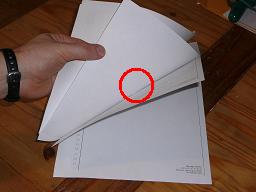 An example of a "booby-trapped" legal brief with the pages still joined together |
I did this after it occurred to me one day that I'd never won a Small Claims case against a spammer or telemarketer where the defendant had showed up in court. Sometimes the judges said the spammers were not liable, sometimes they said that the subject line of the spam was not misleading enough, and sometimes they simply said that they were going to make an exception under the law ("It was just one phone call"). So I asked the handful of other people in Washington that I knew had sued spammers in Small Claims, and none of them had ever won a case against a spammer or telemarketer who appeared in court either. (The only Small Claims victories had been out-of-court settlements and default judgments where the defendant didn't show up.) It wasn't because most judges said that the cases couldn't validly be brought in Small Claims court, it was simply that the number of times the defendant appeared and the judge ruled against them, was zero. Now, there were only a handful of us suing spammers and telemarketers in Small Claims, and the defendant only rarely showed up, so we're talking about a sample size of dozens of cases, not hundreds, and I'm sure some of those were cases where reasonable people could disagree. But still. Zero?
I knew when I started suing spammers in 2001 that many judges would have attitudes similar to this guy:
Actually, I like honesty, and Judge Nault is like the hot chick who just tells you that she doesn't like your looks instead of making up some crap about your personality. But after getting similar (but usually more subtle) messages from so many different judges, I thought it was worthwhile to test whether the motions I was filing were being read at all. The 6 test case motions were all filed as part of the formal cases, so the judges were at least theoretically required to read them -- and each one was about facts unique to that case (that is, I wasn't handing in a copy of something that I had already handed in a million times before, that wasn't why they were being ignored). I posted the complete list of all the test cases here.Judge Nault: You know what I think about these cases?
Bennett Haselton: Uh... what?
Judge Nault: They stink.
Bennett Haselton: Really? Why?
Judge Nault: I don't have to answer your questions, you have to answer mine.
Bennett Haselton: OK.
[...]
Judge Nault: I just think this is the stupidest law in the world. But I didn't write the law and I'm bound to follow it. So I'm gonna go ahead and give you your money. But I'm just saying, it just takes up court time and it's absolutely stupid.
I realize, of course, that courts are overburdened and judges have to prioritize what they work on. The problem I have with that excuse applied to these cases, is that often the judge spent so much time haranguing me for filing some "silly" lawsuit, that they could have read the brief forwards and backwards in the same amount of time. More likely, most judges probably just don't think spam is a real problem worth spending time on. (Obligatory rebuttal.) But, strictly speaking, that's not the judge's decision. If the legislature has passed a law making spam punishable, the judges are simply supposed to apply that law, not to be influenced by their opinion about the law. (If a judge asserts a bias in the other direction, that's just as inappropriate, but that has been very rare.)
Well, shoot, I can't complain
If you feel you've been wronged, there is a Commission on Judicial Conduct in Washington for processing complaints against judges for improper behavior. For example, when a certain Judge Gary W. Velie got in trouble for saying "nuke the sand niggers" (referring to the first Iraq war), and for saying in court that a defendant had "gone crazy from sucking too many cocks" and telling another lawyer in court that he looked like he had been "jacking off a bobcat in a phone booth", the Commission flew (by judicial standards, meaning, a little over a year later) into action, and issued a reprimand. Evidently this was an exceptional situation, since the CJC takes action in response to only about 3% of submitted complaints in a typical year. Apparently the last time the CJC actually barred someone from office was in 2005, in the case of a judge who was convicted and imprisoned for molesting an 11-year-old boy. The Commission lists this decision as one of their accomplishments, although I think the judge probably wouldn't have been re-elected after that anyway.
Of the three test cases judges who got caught with the booby-trapped motions, two of them I thought were not really worse than most other judges anyway, but for the third one, I thought filing a complaint was probably justified. This was a case where I had telephoned the spammer before the trial, pretending to be an interested customer, and tape-recorded him making such statements as "Well, I would blast out 5 million for $500" and "It's a United-States-based company but they pump everything through China and then it comes back to the United States". At the trial, presided over by Judge Karlie Jorgensen, the spammer didn't know I was the guy from the phone call, so he claimed that he didn't even know how to send spam and had no idea what I was talking about, while Jorgensen kept Judge-Judying me in between just about every other sentence for picking on this obviously innocent man. After I brought out the recording, she became very flustered for a few moments and then started accusing me of "entrapment". (Entrapment, of course, is where you trick someone into doing something, and then sue them or arrest them for it. That wasn't the case here, since he spammed me first, and I called him afterwards just to get evidence that he was in the spamming business.) In the end she dismissed the case, and never said anything about the statements the spammer had made under oath.
So, that's when I filed my "motion to reconsider" with the pages stuck together, and after I got a letter that it had been denied (no kidding), I went to the courthouse and found the pages still attached. After the rest of the experiment was finished, I filed an official complaint with the Commission on Judicial Conduct saying that my motion had been rejected with the pages still stuck together, indicating the judge didn't read it. A little over a year later, I got a letter saying the complaint had been rejected.
Making a federal case out of it
Fortunately, there is a way to bring future spam suits in federal court, where several lawyers have suggested to me that I'm likely to get better results (with their help, naturally).
First though, I am of course aware that most spam can't be traced to the original sender to sue them, and that a lot of spam is sent by some Russian hacker or some loser in his Mom's basement who wouldn't be able to pay off a court judgment anyway. However, quite a bit of spam can be traced indirectly to companies that paid the spammer to send the spam or paid them for the leads that they generated, and those companies are usually easier to find and easier to collect against. For a while, every time I got a mortgage spam with a link to fill out a contact form, I would fill it out using a temporary phone number in a certain area code. Then I'd see which mortgage companies called me, and I'd call them back saying, "The person who sold you this lead is generated them illegally; you should stop buying leads from them, and should stop buying leads from people without asking where they came from." Then I'd wait until the next similar mortgage spam came in, fill out the form with a new phone number in the same area code, see which mortgage companies called me, and repeat.
Sometimes the mortgage brokers apologized and said they'd stop dealing with the person who sold them the lead. Others were unrepentant and started hanging up on me by the second or third time that I called them to tell them their latest batch of leads was generated by a spammer.
The Washington law lets you sue anyone who "sends, or conspires with another to send" spam if the person "knows, or consciously avoids knowing" that the spam violates the law. If I do file any future spam suits, what I'll probably do is use this method to find mortgage companies that refuse to stop buying leads from spammers, and then sue them for the cumulative liability for all the spam that I got from their lead generators. There are several advantages to doing it this way:
- Unethical mortgage companies are easier to locate, sue, and collect against, than most spammers.
- Rather than waiting for that rare spam that contains enough information to find and sue the spammer, you can almost always trace a mortgage spam to the company that is buying the leads, by filling it in with "bait" contact information.
- If you reach more than $75,000 worth of liability, you can sue in federal court. At least one good lawyer has said that if I built a case in this way against a spam-enabling mortgage company, he'd help file it for no up-front fee in exchange for a percentage of the winnings.
This last advantage is the big one. Whatever most media figures say in their rants against judges, what they usually don't mention is that there's a dividing line between judges at the state and federal levels: to be a federal judge, someone has to put their reputation on the line and nominate you. It's a horribly politicized process, but at least it's something. At the state level on the other hand, any lawyer who wants to be a judge can run for office -- and even then, for most judicial positions there is only one candidate. If we're so cynical about lawyers and politicians, why on Earth do we give a pass to judges, when a state-level judge is just a lawyer who ran for office? In fact, to be a "pro tem" judge, filling in for a day for the regular judge, you don't even have to win an election, you just take a class and then sign up for an available time slot.
Given the vastly greater seriousness of becoming a federal judge, I'll bet that if one of them had been handling the Karlie Jorgensen case, and the spammer said he "knew nothing about any spam" right before being confronted with a tape of his past conversations, maybe the judge wouldn't have sent him to jail for perjury, but the judge probably would have mentioned something about it. And if you had proof that a federal judge denied a motion without reading it, some cynics might not be surprised, but an official complaint at that level would probably be taken more seriously.
Besides, the nice thing about federal cases is that the defendant is likely to have a lawyer who will talk some sense into them and get them to settle out of court, instead of digging in their heels the way spammers often do in Small Claims. They say the best lawyer isn't the one who wins in court but the one who keeps the case from going before the judge at all, and I'm sure that's true even with federal judges. By that standard, I hope that every spammer that I sue in federal court, has a fantastic lawyer.

Judges probably don't like it (Score:2, Interesting)
Re:Judges probably don't like it (Score:4, Funny)
Judges are quick to anger.... (Score:3, Interesting)
Re:Judges probably don't like it (Score:5, Interesting)
Then again, this is Small Claims court. I suspect most judges in said court would prefer to be in a higher court, and probably think of Small Claims as marking time. Also, since suing a spammer deals with the Internet, and the Internet is a global resource, perhaps your typical Small Claims judge feels that it's way outside the bounds of their court, as the amount you're asking for is not terribly high and is probably not going to hurt most spammers significantly.
The only way to get at a spammer in a meaningful fashion is to find others and sue as a group in civil court, IMHO.
And so? (Score:5, Insightful)
What this minor experiment is showing is that we have judges who are abusing their position / authority and ruling from their own beliefs instead of from the Law.
And the mechanism for addressing that issue seems to be broken, also.
Re:And so? (Score:5, Insightful)
Re:And so? (Score:5, Interesting)
I've had a recent run of very important correspondence with some colleagues (some peers, some more senior, some more junior). They're out of country and I'm supposed to provide them a whole bunch of information, usually in the form of answers to their questions that I need to research here to get them the answers. I found they were telling my managers that I hadn't been passing the information they requested, which of course had me e-mailing the managers with a copy of the e-mails I'd previously sent.
Turns out these guys weren't reading the reply. How do I know? Well I followed the same 'booby trap' method. In a couple of e-mails I inserted the words "if you read this sentence, e-mail be back and I'll buy you a case of beer"...
I've only had one request for the case of beer out of about 10 "ZOMG answer this or the world will end" e-mails.
Re:And so? (Score:4, Funny)
Re:Judges probably don't like it (Score:5, Insightful)
Re: (Score:3, Informative)
Some are, some aren't (many states have a mix of elected and appointed judges in different courts.) Not sure which applies to Washington small claims judges.
Elected? (Score:3, Insightful)
If someone were to present the evidence to the voters, would it matter? Who else would th
Re: (Score:2)
Re:Judges probably don't like it (Score:4, Interesting)
The judge thinks you are a crank (Score:5, Insightful)
That being said, if you are unlucky enough to live in a state with elected judges, many many judges are cranks themselves. Enlist an attorney friend at election time and ask them to tell who who the good judges are and who are the cranks.
Typical Small Claims Case No 1: Plaintiff: "Your honor, to keep it brief, I wuz ripped off!" Judge: "I find in favor of plaintiff! Next"
Typical Case No 2: Plaintiff: "You honor it is a gross violation of that most fundamental of Human Rights the US Evil Government and their secret UFO base and allow me assemble my overwhelming evidence that they sap and impurify blah blah blah blah
Beats getting shot while leaving the courthouse. (Score:3, Interesting)
Maybe if these 'judges' knew that they could be lynched at any time...they would put a little more effort in. A judge has got to sleep sometime you know.
YOU are the crank (Score:4, Insightful)
You seem to think we pay to file a claim so we can meet Judge Judy. Hell, no, it is to redress a wrong, even if it costs us more in time and fees than the matter at hand. The principle is what is at stake.
It's called justice, punk.
Maybe... (Score:4, Funny)
Re:Maybe... (Score:5, Funny)
Re: (Score:3, Funny)
Should see intelligent comments on this one... (Score:5, Funny)
Re: (Score:2)
I read about 1/3 of it before getting bored...it's sad that the justice system is so, not corrupt, but like that. Corrupted by a lack of knowledge and care about a relatively serious problem. Unfortunately as I read through the part about the briefs not being read my first thought was "Yeah, what's new?" as it didn't seem all that extraordinary to me for the judge to not really know anything more than the very very rudimentary part of a case.
Re:Should see intelligent comments on this one... (Score:5, Funny)
Job / Hobby / Quest ? (Score:4, Funny)
Re: (Score:3, Informative)
Didn't you read "1984"? (Score:3, Funny)
Tilting at Windmills (Score:5, Interesting)
Re: (Score:2)
Let him have it. It isn't wise to upset a judge. (Score:5, Funny)
That's because average citizens don't throw people in jail for making them look bad. Judges have been known to do that.
*infuriated beeping from Mr. Haselton*
Re:Let him have it. It isn't wise to upset a judge (Score:2)
I smell a conspiracy. (Score:2, Interesting)
Ah-men... The real problem here (a bit long) (Score:5, Insightful)
The real problem here is that it sounds like you sue everybody. Given that you started out by saying "The last few times" you tried to sue a spammer indicates that you've done this quite a few times. Judging from the content of some of the linked pages, it sounds like you constantly sue people in small claims court. The judge is probably assuming that you a)Have nothing better to do b)Don't understand that sometimes, life sucks and you don't get your way, or c) are mentally ill. You know what, they're probably right. I'm willing to bet that the same exact motion, filed by someone else would have been at least read. When you constantly bring people/groups to small claims over the slightest, practically inconsequential injustices you're going to run into a "Boy Who Cried Wolf" situation every single time... even for the important stuff. Despite what people think, those judges have some (comparatively) really important cases to try... such as landlord abuse of low income tenants, or some scumbag employer trying to screw a working mother out of her overtime pay. Understandably someone who, for example, constantly files motions against retail establishments for amounts of less than what it costs to file, even if all of a sudden your landlord decides to withhold your $1500 security deposit for no reason at all, they're going to just assume that you're being a prick again and tell you to piss off.
Although I've never had a job in the legal profession, for a number of years I had a job that I had in which I was asked to make snap judgments about various situations: I was a bouncer in a night club. (another job where it's very easy for people to assume you're a prick for doing your job the exact way you are supposed to) Normally(95% of the time), if a woman would come up to me and complain that a male customer was bothering them, it was pretty safe to assume that they were telling the truth, and depending on the severity of the complaint, I'd either keep an eye on them, go talk to them, or physically toss their ass out onto the sidewalk. However, there were women who would come in, and when someone (in a night club) would have the audacity to wink at them they would storm over to one of us and indignantly demand that the person get thrown out immediately. The first couple of times this happens with someone, you don't have much choice but to at least keep an eye on the person, but after the 5th time in a night, or the 10th time in a weekend, or even the 1st time that someone gets hurt because you're not able to see/respond to a much more serious problem occurring while you were dealing with their idiocy, you tend to just filter the complaints of that person out. It would be a real shame if something actually did happen to that person, but how the hell are we able to tell the difference between a legitimate and non legitimate complaint?
With the idiotic "I pay taxes" BS aside, that judge doesn't work for you... and wasting their time every time you can think up some reason to throw the book at someone won't win you any favor in the judges chamber. Unlike in bars, being a regular won't get you points.
Also, despite the way you are treating this, law suits aren't like an intellectually stimulating argument over whether or not someone violated the rules in a roll playing game, where most of the time the loudest, most abrasive nerd wins. These people have a lot of stuff on their plate to go through in a small amount of time. They are really not interested in hearing your long winded, overly detailed, explanation of every single possible way in which the defendants actions could have possibly annoyed you. There is a certain amount of respect you have to have for court room etiquette, and the time constraints of the people involved.
Also, on your linked page where you described the incident where you made the tape of the person agreeing to send out spam for you... you said that judge was constantly attempting to interrupt you. If you don't understand that when th
Re: (Score:3, Insightful)
Yes, expecting judges to follow the law is an unreasonable assumption. If the laws are bad, they should be changed, not have judges break the law and their oath to fast-track the ignoring of a valid (if frivolous) complaint.
A better method... (Score:3, Funny)
LOL (Score:2)
talcum powder and grease, oh my. you'll be on the evening news in six countries, live by satellite.
My advice... (Score:3, Funny)
By the way, whatever happened with your lawsuit against the girl who went out with you and didn't pay half?
The older I get (Score:5, Interesting)
We pretend to have a democratic system where the little guy has equal footing but in reality it is just propaganda to keep us docile. The entire system is basically set up to keep us working and consuming as slaves and to not get mad and spill over into a revolution.
It is really about naked power with random assertions of right and wrong used as cover for the attacks. That's why some times a charge will stick (it has a lot of power behind it) and other times, the person just gets away with doing the same thing (they have more power).
However, I would say that it has gotten worse (more obvious) over the last 20 years.
no (Score:5, Insightful)
Re: (Score:2, Informative)
Actually, judges are generally are permitted by law to reject out of hand motions which are filed in forms that don't meet the rather detailed format requirements most courts have, though I think usually they are required to notify the filer of the problem and provide an opportunity to correct the defect. I'm wouldn't be surprised if hav
NSFW article? (Score:3, Interesting)
Thanks, Slashdot. Now my employer probably thinks I'm a racist pervert.
Re: (Score:3, Funny)
Doing *what* to a *what*? (Score:5, Funny)
Ok...wow. I was not previously familiar with this expression, and I'm not even sure how he came up with such a colorful simile, but I think I'm going to have to start using it.
I'm so enamored with it that I actually tried to close my <blockquote> with a </bobcat> tag. Got halfway through the first paragraph before I noticed.
You may have to explain to the youngsters... (Score:3, Insightful)
Re: (Score:3, Informative)
"I'm so p*ssed off I could jack off a bobcat in a phone booth with a hand full of razor blades"
or (another variant):
"I'd rather sandpaper a bobcat's butt in a phone booth than X" (where X is some undesirable task).
He was an ex-Marine from Texas, so take your pick where the line originated.
Official Complaint (Score:3, Funny)
No surprise there. Now you have to stick the pages of the official complaint together, and file a new complaint about your orignal complaint not being read.
Re: (Score:3, Informative)
From the reading of the story, it is difficult to know which is which.
As an attorney explained elsewhere, a motion would be rejected for not complying with court rules. If the motion is denied, that is on the merits.
So if they were, in fact, rejected, then it may not have been necessary to read them because the lack of compliance with court rules could have already been noted.
Perjury (Score:5, Interesting)
Re: (Score:2)
It should be possible to bring charges against this judge for abuse of authority.
Local DA (Score:3, Interesting)
The question then arises : Will the DA be interested in doing this?
Yes, it may well be perjury. It may be against the law and deserving of jail time.
But.... Does the DA have a real interest in challenging a judge on something like this. DA's present cases before judges, need judges to sign warrants, and generally rely on a judge's good impression of a DA to do their jobs. Irritating (even in a small way) a judge by challenging their rulings is not at all likely to make the judge feel all warm and
Am I the only one... (Score:5, Insightful)
It's not like this is going to eliminate spam, and it's not even like going the small claims court route is something that I find personally worth the effort. But that doesn't mean I'm inclined to think less of someone who does take legal action.
Re:Am I the only one... (Score:5, Insightful)
I think this was actually a clever thing to do, and I'm glad that there are people going after spammers while simultaneously exposing lazy-assed judges and a malfunctioning judicial system.
Even if this effort might be scorned as a "hobby" or "waste of time", I think it's more noble and worthwhile than the efforts of the average open-source contributor.
Re: (Score:3, Interesting)
And what the author is doing is pretty smart, and not easy to do. I used to get 3 to 5 calls a day from robots offering me satellite TV. Yes, a day. I would typically have 2-4 voicemails when I got home form work and then receive several more calls. "Gee, I didn't want this the first 37 times you called, but your 38th call has won me over."
Anyway, they were all from fake numbers with fake names, they never mentioned what company they worked for, and there was no way off their list (and I think al
Absolutely Detestable (Score:2)
If the state doesn't profit from it.... (Score:2)
They don't mind minor drug cases clogging the system, because the state gets large fines from the drug user. But having a lot of spam cases in small claims court, well, that just wastes their time.
As someone who has spent some time in front of a judge, this doesn't surprise me in the least.
Well, it's no wonder (Score:2, Troll)
Legal system is so screwed up anyway (Score:4, Informative)
I'll give you another example: Traffic cops:
Ok, you're speeding or doing something else bad (broken taillight, loud muffler). You get a ticket.
You claim "not guilty" and actually go to court.
-You let a lawyer handle it (I do), it takes at least 2 appearances and you'll get a great discount. You'll also see some discrepancies, the lawyer actually never goes to court, but you'll receive a letter from your lawyer 2 days before the appearance date that he made a good deal (2 points instead of 4).
-You do it yourself (I tried), it takes the first appearance which you'll have to be there and you'll get either the full fine, or some minor discount, depending on the mood of the judge. The eyewitness of the cop that pulled you over apparently has more weight as a witness than 2 persons that were in the car and saw what happened.
Another thing you can confirm with any police officer: He goes to court on his off-time (because they're almost always either in the early morning or late night), gets an hour or more paid overtime (2x or 3x, sometimes up to $100), even if he was there only for 5-15 minutes. The cost of the ticket is somewhere close to $150 in NYS, the judge has to be paid, the cop has to be paid, the court building, the clerk etc. etc.. Actually, the state is LOSING money on your ticket, even if you're guilty as charged.
In the mean time, that officer could be on the streets doing his work or while he pulls you over for some minor traffic infraction (oops, you're going over 10 mph on a highway with a 35mph zone) he could be doing his work. I got pulled over near a school, because the cop thought I might be going too fast (I wasn't). In the mean time school kids (6th-8th grade) were walking by with CIGARETTES, spitting on the pavement right next to my car. I mean, come on, the cop looked at them and just sighed...
I got pulled over in Buffalo, NY, I wasn't doing ANYTHING wrong (just checking if I had been drinking, I hadn't, and then they just kept on looking to find a problem with my paperwork), in the mean time, not even 10 yards away, people were obviously dealing drugs in front of a convenience store. I made a remark on it, because they already kept me busy for 15-20 minutes, they said something like: "well, we do our job the way we see fit, you just sit there and shut up". They drove off, never even checked on the drug dealers.
little off topic: Legal system is so screwed (Score:3, Insightful)
Judges and lawyers do abuse the system... there is no question on that. Cops also abuse the system. So do our pollies and public servants who administer the system. In part, the cops are just doing what they are ordered to do.
You are correct that if you go to court the state loses money. They count on people not going to court. Hence I think it is perf
Wrong (Score:3, Insightful)
Re: (Score:3, Informative)
In Oregon, for example, it is perfectly legal for a party of any telephone conversation to tape the phone call. They do not need permission of the other party. Note that this only would legally cover calls within Oregon..
How are we supposed to know the law? (Score:3, Insightful)
I am sure that we all get the basics (no killing, no adultery, no stealing) from when we are kids. But why don't we have basic law taught to us just as we have basic language and math? How many times people break laws simply because they didn't know them? I think that is something to think about.
BTW, I am not fro
Re: (Score:3, Informative)
You cannot record anyone without permission unless you have a court order.
No, some states prohibit that, and some don't. [callcorder.com] Federal law does not. For the states that prohibit it, it only applies to calls where both ends are in the state, since across state lines, federal law applies to telecom.
actually, I played a disclaimer before taping it (Score:5, Informative)
The full details are at the link given in the story:
http://www.judgejokes.com/karlie-jorgensen.html [judgejokes.com]
Without that disclaimer, you would have been correct though.
The Judge was right (Score:5, Informative)
I don't have the time or energy to go through the transcript and give you a point-by-point defense of the Judge's ruling, or to show you where your case was lacking. I also have no intention for you to take this as legal adivce. But I feel the need to comment on several things that you need to think about if you're going to keep doing this:
1. The Judge rightfully got irritated with you because, like most laypeople, you don't know the difference between fact and law and between testimony and argument. A trial has two phases: presentation of evidence, then argument. During the presentation of evidence phase, the judge doesn't want to hear *why* you think the law applies; she wants to hear facts -- what happened, to whom, when, etc. Presentation of evidence is done on a witness-by-witness basis -- you call your first witness (in your case, it should have been you), and you present all of the evidence that witness has to give. Then you call your next witness, and present all of the information *that* witness has to give, etc. You jumped between questionning Spies, offering your own testimony, and offering argument, the questionning Spies again. That jumbles the presentation of evidence, and annoys judges.
2. Your theory of the case was not well-presented. Again, laypeople often don't have the training to present a legal argument in an easy-to-digest manner. I've always thought that the best way to teach how to do it is to think of the old proofs you had to learn in Geometry -- i.e. these things [sparknotes.com]. You want to prove that Joe Spies sent you an e-mail. To prove that conclusion, you have to break that down into separate pieces- (a) you received an e-mail; (b) the e-mail contained a remove link to FullServices.com; (c) I looked up FullService.com's registration; (d) the registration lists a phone number of XXX-XXX-XXXX; (d) I called that number, and someone answered; (e) I asked that person's name; (f) the person said "Joe Spies"; etc. (Note that each step in the chain refers to something that is proven in the step before it. That's a chain of logic -- it's how things get proved, in geometry, or in court, or anywhere.) Before you ever go into court, outline your case exactly like this, and when it comes time to put on proof or to summarize you proof in a closing argument, work through this outline.
3. Of course, having a great outline doesn't work if you don't understand what it proves. In the chain I mention above, you have not proven that Joe Spies sent you an e-mail. You've proved that you received an e-mail, that a website is mentioned in that e-mail, and that Joe Spies answers the phone at the registered phone number of that website. That's it. Someone might reasonably *infer* from these facts that Joe Spies sent you the e-mail, and a circumstantial inference can be enough to prove a case, but under these facts, the inference isn't very strong. You didn't track headers to show FullServices.com is the sender of the e-mail (and you probably can't -- it probably came from a bot, or broken relay). You assumed that FullServices.com conspired with the sender simply because it is listed in the e-mail, but that assumption isn't warranted. You don't account the possibility that FullServices.com is just an innocent company hired by a spammer to maintain a remove list. The only proof you had that FullServices.com was somehow involved was your phone call, which has its own problems. Without any other proof of FullSerivce.com's involvement in the sending, you didn't prove Spies violated the law.
5. The Judge properly refused your transcript of the call for several reasons. First, I haven't looked up the law in Washington, but if it requires both parties' c
Re:actually, I played a disclaimer before taping i (Score:4, Informative)
http://www.judgejokes.com/booby-trapped-filings.h
Although, the judicial elections are over and most of them don't come up for re-election again until 2006...
Besides, part of my point was that all of the existing safeguards -- elections, appeals, a commission for investigating complaints -- are already there, and weren't enough to prevent this from happening. What would be enough? I don't know. I am moving on to federal court to try my luck there. But I feel bad for all the people who are forced to go to district court, for criminal matters and serious family issues like child custody.
The inevitable conclusion... (Score:3, Insightful)
Glad someone is actually doing this.. (Score:5, Interesting)
Fun Stat:
I admin a small ISP. We received about 80k emails per day, of which about 97% are rejected by our various antispam technologies (RBL, Bayesian, etc). To reject one message as spam, it takes as many as dozens of DNS queries and such (since many anti-spam technologies rely on the DNS infrastructure to propagate the Block List). So that 1KB spam can generate 10x or more in traffic to kill it. So those who try to trivialize spam as just a nuisance have no idea what it takes to deliver your email, relatively screened-out. And guess what, next week, if another major spammer enters the biz, these numbers could double or more, just on the whim of some spammer.
I'm wondering... (Score:5, Interesting)
"stupidest law" (Score:5, Insightful)
Erm, is the judge telling you that you are spamming the court with useless suits?
Is he saying that the law forces him to lose time handling spam?
Well, is he for or against spam? I am confused...
A modest proposal (Score:3, Interesting)
The thing about small claims court (Score:5, Interesting)
And that was the end of that.
Later, someone who identified themselves to me as an attorney told me that this was the way small claims was supposed to work. Small claims was, supposedly, where anybody could go to get justice without a lawyer and without anybody getting tripped up on technicalities (which, apparently, a clearly written contract can be if the judge so decides).
I can sort of see the idea. If some slickster is ripping off poor people via incomprehensible contracts, it would be nice for them to have some place to go to say "Please do the *right* thing and help me out." In fact, very small dollar disputes in small claims in Texas (under $25, iirc) can't be appealed through the state courts at all; there is simply no intervening authority between small claims and the U.S. Supreme Court. (Which allowed a landmark suit about voting rights to jump to the Supremes in record time some decades ago, but that's another story.)
No matter how much slack I'm willing to give to small claims judges, though, not even reading a motion is just stupid and corrupt. I sincerely hope this story is getting some press play back home.
Read the court transcript (Score:4, Informative)
Now, I agree that the accused was probably a spammer and should have punished for his crimes, but Mr. Haselton did NOT argue his case very well. I think the dismissal of the claims was more a result of Mr. Haseltons poor presentation than anything else. He was not particularly organized, presented too much irrelevant information and had a poor flow. It is true that the judge interrupted him a number of times, but IMO it was simply to make Mr. Haselton get to the point.
At the beginning of his presentation, Mr. Haselton did not clearly explain the technical details. I'm still not quite sure what bulletproof-hosting is and why it makes the spammer liable for damages. It appears the judge felt the same way. Second, Mr. Haselton's evidence wasn't particularly compelling since he didn't produce the tape, nor did he produce the disclaimer. That might be irrelevant to the case (IANAL) but the judge clearly wanted it.
I don't want to be hard on Mr. Haselton since he's not a lawyer, but it appears that he lost due to a poorly argued case rather than judicial corruption and incompetence. As an aside, this proves why people hire lawyers in the first place; they know how to present information in a logical and clear manner, and know what the judge is looking for.
Who is haranguing who? (Score:3, Insightful)
IANAL, and I'm near-certain HINAL either. That being said, the example of his "sting operation" [judgejokes.com] (which he seems quite proud of) is a great one. It seems that he believes the spammers came to him with an offer by spamming him. Sure, I'll grant him that spam is annoying. Sure, Joe Spies should rot. Yes, Joe lied in court; However Bennett still initiated the contact with FullServicesOnline seeking to "purchase" spam. In my understanding it's still entrapment, whether or not someone else has used the same system against him.
I can't recall where exactly, but somewhere this d-bag mentioned that "it's not like his claims are all the same". What about this page [judgejokes.com]? And in all honesty, how different can the motions be when they're all coming off as "I am on a crusade against spam!"
So basically, this guy just reminds me of Michael Crook [boingboing.net], with a slightly better means. Bennett is an attention-whore, using his (misinterpreted) views of the law to try and "crack down on spammers" ultimately (it seems) to get mentioned in the news. He's a 28-yr-old programming contractor, upset that he hasn't amounted to anything more. Get over it, grow up, stop haranguing the judges and judicial system, and for the love of god stop posting self-publicizing crap to
Re:I don't get it (Score:4, Insightful)
Because issues concerning the Internet and how the American Judicial System is willing or not willing to act when it's abused is "news for nerds" and "stuff that matters"?
What, praytell, does your vision of slashdot look like, if this would fail to qualify?
Re:I don't get it (Score:4, Interesting)
A. Is there a mandate that Slashdot is "technology only"?
B. Just because ALL US citizens should be concerned about this doesn't prevent it from belonging to a specific interest site, especially when the application has shown to be relevant to that special interest.
They aren't "glued together" (Score:3, Informative)
Re: (Score:2)
Re: (Score:2)
Re:If I was a judge... (Score:5, Insightful)
IANAL (or judge), but in my limited experience, the first page is nothing more than a 'cover' page, describing the case number, date(s), names of the parties, jurisdiction, presiding judge, etc.
It contains no factual evidence as to the facts, evidence, or validity or lack thereof of the motion. So, his 'boobytrap' *does* mean that the motion was not read, other than the basic information as to what case it pertains to.
Basically, the judges are looking at the cover page and saying; "I'm not wasting my time with this, regardless of the facts or any duty of mine as a judge to actually rule on the law. The legislatures' decision to create this law and the constitutional rights of the victims of the lawbreakers to redress can go hang!".
Strat
Re: (Score:3, Insightful)
As for the judge reading the opening part of the motion-- he cannot do that (in theory)-- he must read the entire document before making a decision. The fact that the seals were in tact means that he did not read it, probably at all, definitely not beyond the cove
Re: (Score:3, Insightful)
(Which the article author is not in any thereof...) the Judge doesn't HAVE that option. They're not
supposed to ignore filings like that in the lower courts. It's a valid motion- in order to even say
"no, I'm not giving in on this," the Judge in question HAS to read the motion to come to that same
conclusion unless they're declared a vexatious litigant, which I suspect is not the case here.
Re: (Score:3)
In all cases the judges dismissed the cases due to the contents of the documents they had clearly not read at all.
It's a clear case of prejudice from the judges part. They had already decided before reading the filing that the spammer was to get set free. It's a pretty serious miscarriage of justive if you ask me. Same sort of shit happens
Re: (Score:2)
Re: (Score:3, Informative)
In the majority of states on the US, only one party needs to consent to taping. Reference [callcorder.com]
Re:illegal to tape a phone conversation! (Score:5, Informative)
Re: (Score:3, Informative)
Re:illegal to tape a phone conversation! (Score:5, Funny)
Wow. So, I've impeached President George W. Bush. Repeatedly.
I'm putting that on my resume. Right now.
Re: (Score:2)
Re:illegal to tape a phone conversation! (Score:5, Informative)
Federal law allows recording of phone calls and other electronic communications with the consent of at least one party to the call. A majority of the states and territories have adopted wiretapping statutes based on the federal law, although most also have extended the law to cover in-person conversations. Thirty-eight states and the District of Columbia permit individuals to record conversations to which they are a party without informing the other parties that they are doing so. These laws are referred to as "one-party consent" statutes, and as long as you are a party to the conversation, it is legal for you to record it. (Nevada also has a one-party consent statute, but the state Supreme Court has interpreted it as an all-party rule.)
Re: (Score:2)
Wrong. It depends on the state you're in, and most states do not require the consent of both parties. http://www.rcfp.org/taping/ [rcfp.org]
Re: (Score:2)
Re: (Score:2)
In some jurisdictions.
In many others it's legal if one party to the conversation is aware of the recording.
Not necessarily... (Score:2)
Re: (Score:2)
Re: (Score:3, Insightful)
Seriously, grow up. Judges have better things to do than uphold laws they don't understand.
The above quote pretty much sums up the failures of our current 'justice system', the public who fails to hold them accountable,
and the criminals complete lack of fear about breaking these laws.
Corporate and political lobbying took all the teeth out of these SPAM and Telecom laws, but Congress put the 'Small Claims' remedy in there so there
appears to be some sense of justice/enforcement. Even that remedy has failed.
Re:I see what the problem is. (Score:5, Insightful)
As opposed to the Clinton era, where justice was for the rich.
Re: (Score:2)
Re:I see a trend... (Score:5, Insightful)
Far worse is the problem of stupidity. I find it hard to believe that even local judges believe spam is not a problem, and that the anti-spam laws are "bad". What planet have these people been raised on, and what have they been smoking (and where can I get some)? Or were they simply bought for the day by the spammer?
Re:I booby-trapped my son (Score:5, Funny)
My wife got a "Daily Bread" (a bible based daily devotional) each month from her Grandmother from when she was a teenager till she turned 18. When she was in her twenties she had a conversation with one of her cousins (same grandmother), who claimed to have "saved her Daily Bread" for part of the down-payment on her new car. Seeing the look of confusion on my (not yet) wife's face, she explained that she had saved the $10 dollars she got in each of her "Daily Breads" each month!
Apparently my wife (to be) was able to find a few of them still in her bookshelves, and confirmed that they did indeed have $10 in the centers. My wife figures she must have recycled out at least $500.
She never told her Gran.
gus
Re:Can I suggest model railroads? (Score:5, Insightful)
Re: (Score:3, Informative)
Tell this to the tech support centers that get calls all day long from angry customers complaining about the amount of spam they receive.
I'm a very small ISP and I get calls twice a week about spam. This is after it's gone through Spamassassin. I have customers getting 200 spam emails a day that make it through Spamassassin. I know it's the
More importantly... (Score:3, Funny)